


Eco-Friendly Cutting Boards: Non-Toxic and Dishwasher-Safe
Your cutting board is slowly ending up in your food. The material used matters. End-grain hardwood is the overall winner. Titanium is the specialist tool. Here’s why, and which to buy.
The Cutting Board Under Your Knife Has a Problem
Most kitchens have a plastic cutting board. Many have two. They’re cheap, they’re light, and they’re quietly introducing plastic into every meal you prepare.
A peer-reviewed study published in Environmental Science & Technology found that a polyethylene chopping board could expose a person to between 14.5 and 71.9 million microplastic particles annually, and a polypropylene board to as many as 79.4 million. Estimated annual exposure by weight ranged from 7.4 to 50.7 grams, roughly equivalent to 10 plastic credit cards.
Washing the food doesn’t help much. One study found that rinsing chopped food for a full minute removed only a small fraction of the microplastics. The vast majority stayed attached to the food.
A 2025 mouse study that fed animals microplastics generated from real plastic cutting boards found that polypropylene boards led to gut inflammation and that both PP and PE boards significantly altered gut microbiota and liver metabolism. The researchers concluded that no plastic cutting board can be considered entirely safe, and recommended minimising their use and replacing them regularly. The problem with “replace them regularly” is that each replacement is another piece of plastic headed for landfill; it continues shedding as it degrades there.
Switching to a non-plastic surface is the right answer. But not all non-plastic surfaces are equal.
Why End-Grain Hardwood Is the Best Material Overall
Four dimensions matter for a cutting board: knife safety, hygiene, sustainability, and durability. End-grain hardwood leads or ties on three of them, making it the best cutting board material.
The End-Grain Difference
Most wooden boards are edge-grain or face-grain. The board is made from planks with their sides or faces running along the cutting surface. The fibres run parallel to the knife. Every cut scores across those fibres, creating visible grooves over time that harbour bacteria and eventually cause the board to split.
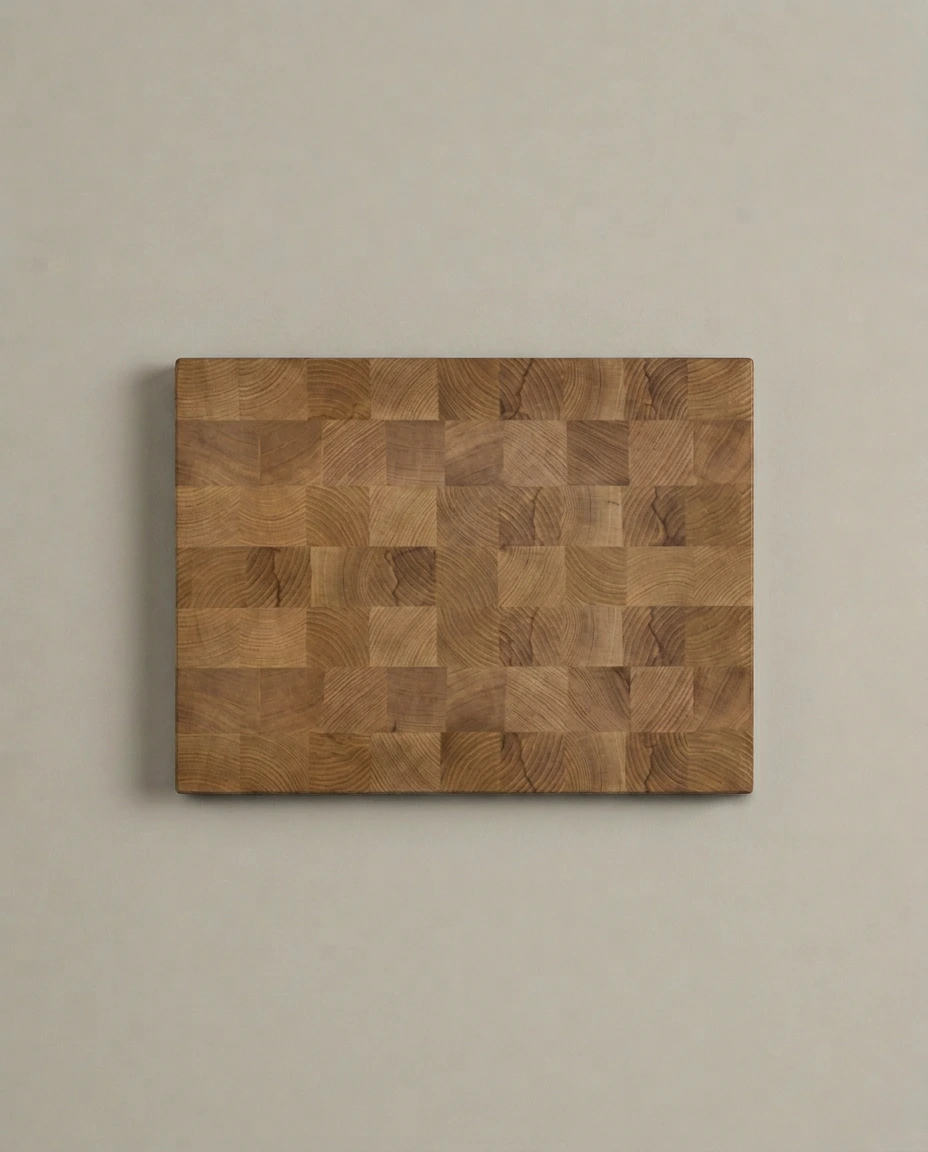
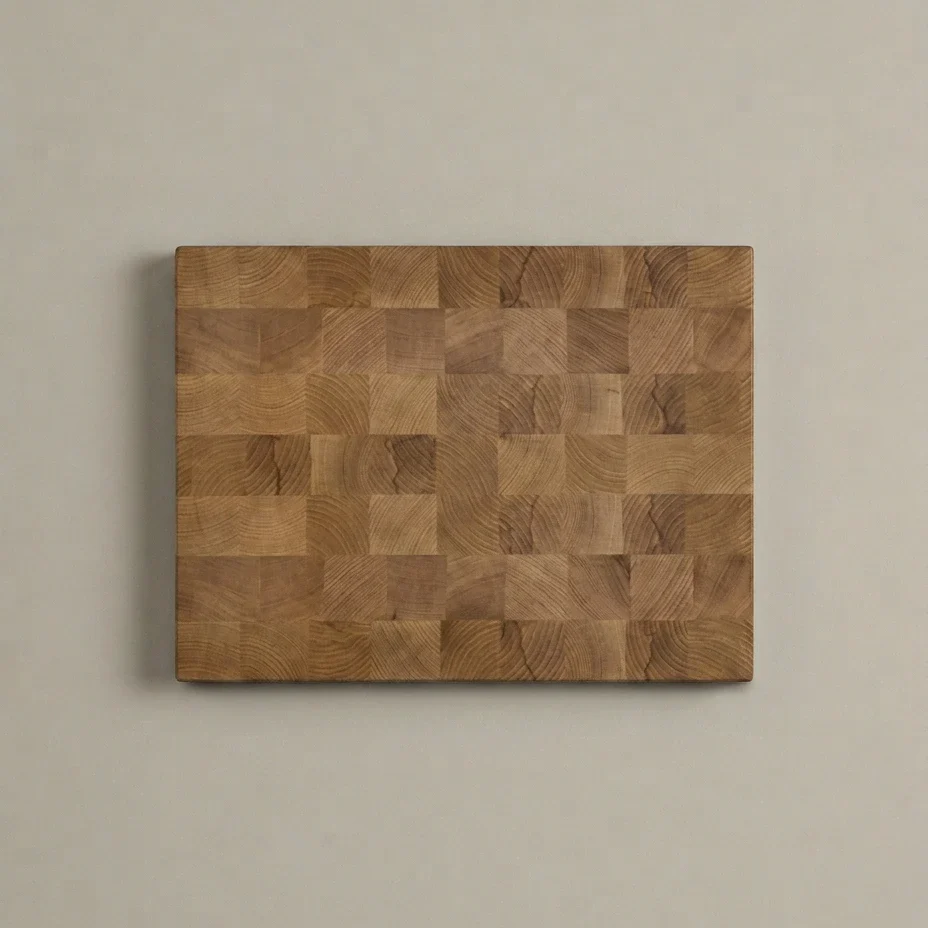
End-grain construction orients the board so the cut ends of the fibres face upward. This is the cross-section of the wood, not the length. When a knife descends on an end-grain surface, it passes between the fibres rather than cutting across them. The fibres close back around the blade path after each cut. This is the self-healing property of end-grain boards that edge-grain and face-grain boards cannot replicate.
The practical results: far less visible scoring even with years of daily use, longer-lasting hygiene performance, and the gentlest possible contact for a knife edge.
Knife Safety
End-grain is the best surface you can put a knife on. It is softer than titanium, ceramic, glass, and steel, and the between-fibre cutting action means the blade experiences less drag and less edge deformation per stroke than any other board type. Your knives will stay sharp longer. This isn’t marginal; knife care professionals consistently recommend end-grain hardwood as the default for daily prep work precisely for this reason.
Hygiene
The standard objection to wooden boards is bacteria, and it’s worth addressing clearly rather than dismissing. Wood is porous. Bacteria can penetrate the surface. The caveat on the comparison table below is honest.
The important context: research from UC Davis microbiologist Dean Cliver found that bacteria drawn into wood fibres do not readily multiply and die off over time under normal kitchen conditions. The self-healing end-grain surface provides fewer persistent grooves than an edge-grain board. And a board that is properly dried between uses and periodically oiled maintains a surface that is considerably more hygienic than a heavily scored plastic board, which provides the grooves for bacterial persistence without any of the natural antimicrobial properties wood has been shown to have.
The honest summary: wood requires more care than titanium. If you maintain it (hand wash, dry upright, oil occasionally), it is a hygienic and safe daily cutting surface. If you do not, it degrades faster than titanium would. The maintenance requirement is real, but it is manageable.
For raw meat prep, particularly in high-frequency or high-risk contexts, titanium’s non-porous surface is the more defensible choice. That’s what the second option on this page is for.
Sustainability
Wood is the most straightforward sustainable material in this comparison. A well-maintained hardwood board from responsibly sourced timber lasts decades. It biodegrades at the end of its life. It requires no energy-intensive industrial processing. Wooden Amsterdam sources European hardwoods (oak, walnut, ash, beech, and sapele), and the boards are made by European woodworkers, keeping the supply chain notably short for a finished kitchen product.
No microplastics. No synthetic inputs. No coatings. Nothing that goes to landfill at end of life except organic material.
Wooden Amsterdam End-Grain Hardwood Board
Wooden Amsterdam End-Grain Solid Wood Cutting Board. Oak, walnut, ash, beech, or sapele. Made by European woodworkers.
🌳 End-grain construction: knife edges fall between wood fibres, which close back up. Self-healing surface that stays looking good for decades.
🔪 Best for your knives of any material: blades last longer between sharpening than on any other board type
🚫 Zero microplastics: wood sheds nothing synthetic into food
🌿 Sustainably sourced European hardwood: five species to choose from, each board unique
🧴 Low maintenance, not no maintenance: hand wash, dry upright, oil every few months. Honest caveat, fully covered below.
⏳ Lasts decades with care: the kind of thing that gets passed down
Available in: Oak · Walnut · Ash · Beech · Sapele
Sizes: 40×30×3.8cm | 60×40×4.2cm
Wooden Amsterdam was founded in 2016 from a love of traditional wood craftsmanship and Amsterdam, and their cutting board range reflects both. The boards are part of their REDboards sub-line (Robustness, Elegance, Durability), made by European woodworkers to a standard that positions them explicitly as lifetime kitchen tools rather than periodically replaced equipment.
The five wood types:
- Oak: dense, strong, with a distinctive open grain. One of the most durable hardwoods for kitchen use. Warm, golden-brown tones that deepen with age and oiling.
- Walnut: considered the premium choice for cutting boards. Slightly softer than oak (gentler on knives), rich dark chocolate tones, and the most striking visual grain. Each walnut board is genuinely unique.
- Ash: lighter in colour, tight grain, harder than both oak and walnut. Excellent durability, slightly more utilitarian aesthetic.
- Beech: fine, even grain, pale and consistent in appearance. The classic European kitchen hardwood. Excellent value position in the range.
- Sapele: an African hardwood with a distinctive interlocked grain that produces a ribbon-like pattern. Visually the most distinctive option. Slightly more exotic supply chain than the European woods, worth noting.
Sizes:
- 40×30×3.8cm, the standard daily-use size. Fits most counters comfortably.
- 60×40×4.2cm. Large format, better for whole-animal work, pastry prep, or using the board as a serving surface for cheese and charcuterie.
Includes free worldwide shipping.
How to Care for Your End-Grain Board
After every use: hand wash with warm water and mild soap. Do not submerge or soak; water penetrates wood fibres and causes swelling, warping, and eventual cracking. Rinse quickly and dry.
Drying: stand the board upright on its edge to dry, not flat on the counter. Airflow on both sides prevents moisture from accumulating on the underside and causing uneven expansion.
Oiling: every two to four weeks initially, less frequently once the wood is seasoned. Use food-safe mineral oil, board cream, or coconut oil applied with a cloth, left for 30 to 60 minutes, then wiped off. Oil prevents the wood from drying out and cracking and creates a surface less hospitable to bacterial penetration. This takes five minutes. Do not skip it.
If the surface shows knife marks: a light sand with fine-grit sandpaper followed by oiling restores the surface. A small amount of physical intervention returns the board to its original state in a way that no plastic board can ever replicate.
Do not: put it in the dishwasher, leave it next to the hob, or store it flat in a drawer where it can’t breathe.
Tavari Titanium Board
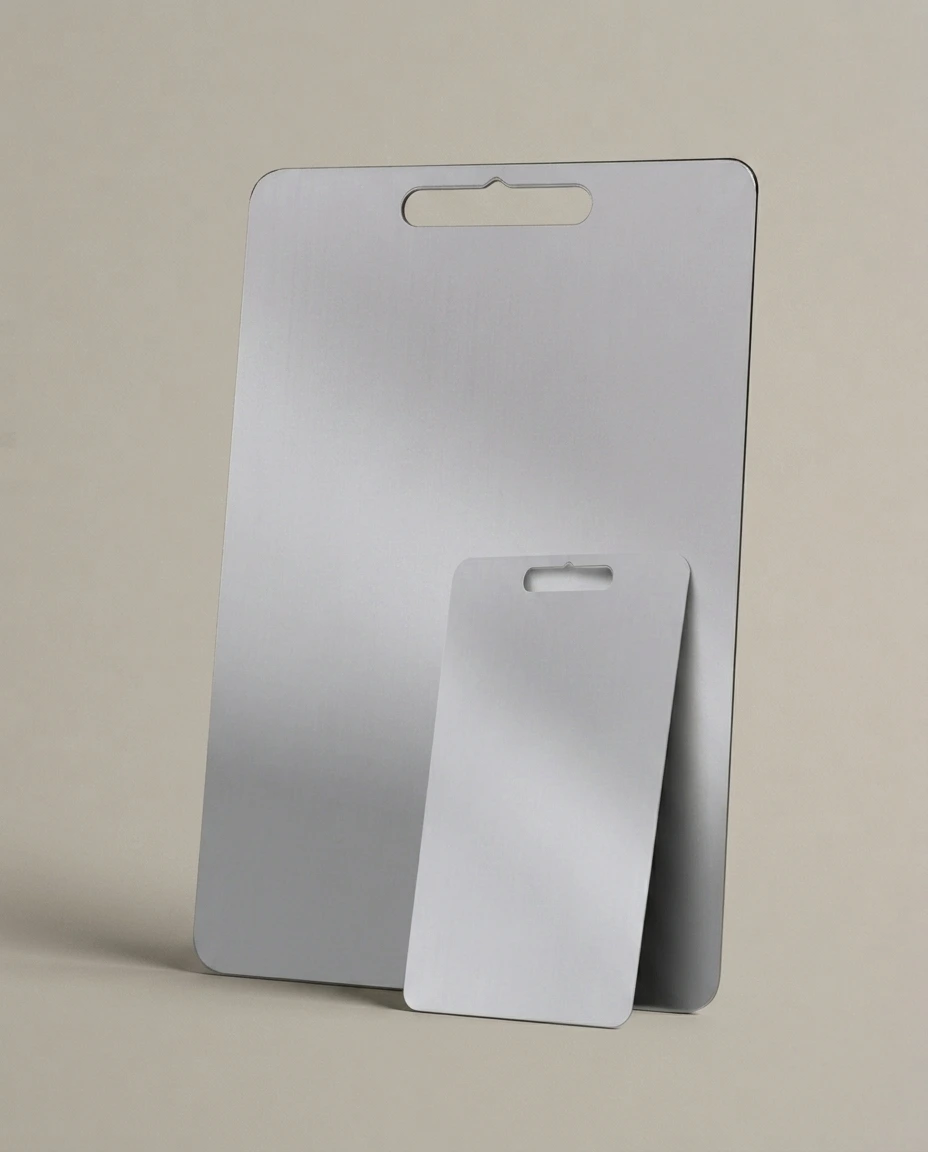
Tavari 100% Pure Titanium Cutting Board. Dutch brand, dishwasher-safe, zero microplastics.
🚫 Zero microplastics: non-porous surface sheds nothing
🦠 Naturally antibacterial: surface oxide layer disrupts bacterial cell membranes
🏥 Medical-grade biocompatibility: same material as surgical implants, trusted for 70+ years
🧼 Zero maintenance: dishwasher safe, no oiling, no seasoning
🔪 Trade-off on knives: titanium is harder than wood; blades need more frequent sharpening
♻️ Fully recyclable: never goes to landfill
Tavari is a Dutch company from Heerhugowaard, one of the few brands in this category that Dutch comparison sites and independent reviewers consistently verify as genuinely 100% pure titanium rather than a steel alloy with a titanium coating. At 590 grams for a 36×25cm board at 1.5mm thickness, it passes the most reliable consumer test: real titanium is approximately 45% lighter than steel of the same dimensions.
Where Titanium Earns Its Place
The case for the Tavari board comes down to specific use cases rather than general superiority:
Raw meat prep: the non-porous surface provides the most defensible hygiene profile for any surface that regularly contacts raw chicken, pork, or fish. No fibres to harbour bacteria. Dishwasher safe at full temperature. This is a genuine advantage over wood, regardless of how well the wood is maintained.
High-hygiene households: if someone in the household is immunocompromised, elderly, or a young child, the zero-compromise sanitation of a titanium surface is a reasonable choice to prioritise.
Minimal maintenance: no oiling, no careful drying. Rinse, dishwasher, done. If you know you won’t maintain a wooden board properly, the titanium board’s durability under neglect is a practical feature rather than a concession.
As the second board: many households will find the right answer is both. A Wooden Amsterdam end-grain board for daily vegetable and fruit prep, and the Tavari for raw meat. The combination gives you the knife-preserving benefits of wood for 80% of your prep work and the maximum hygiene of titanium for the 20% that involves raw protein.
The knife trade-off, stated clearly
Titanium is harder than hardwood. Your knives will need sharpening more frequently than on a wooden board. This is not a dealbreaker; titanium is still substantially gentler than glass, ceramic, or steel boards. But it is the material’s meaningful practical limitation as a daily chopper. If knife care matters to you, use the wooden board for daily prep and the titanium board for meat.
It’s also worth noting that titanium rings against a knife blade make a sharp, metallic clatter that wood absorbs silently. If you share a kitchen wall with a sleeping baby or a light sleeper, that’s worth knowing before you commit to chopping carrots on it at 6 a.m.
Not all titanium boards are what they claim
The market has been filled with boards labelled “titanium” that are actually stainless steel alloys with a titanium coating or trace titanium content. These boards don’t carry the antibacterial oxide layer, the biocompatibility, or the non-reactive properties of pure titanium. Tavari is one of the few brands Dutch consumer sites specifically identify as genuinely 100% pure titanium, which is why it’s the one on this page.
How They Compare: End-Grain vs. Titanium
| End-Grain | Titanium | Plastic | Edge-grain wood | |
|---|---|---|---|---|
| Microplastics in food | None | None | Millions per session | None |
| Knife friendliness | ⭐⭐⭐ | ⭐⭐ | ⭐⭐ | ⭐ |
| Hygiene with maintenance | ⭐⭐⭐ | ⭐⭐⭐ | ⭐ | ⭐⭐ |
| Hygiene without maintenance | ⭐⭐ | ⭐⭐⭐ | ⭐ | ⭐ |
| Sustainability | ⭐⭐⭐ | ⭐⭐ | ⭐ | ⭐⭐ |
| Durability | Decades with care | Indefinite | 1–3 years | 5–10 years |
| Maintenance required | Hand wash and oil | Dishwasher | Rinse | Hand wash and oil |
| Dishwasher safe | ❌ | ✅ | ✅ | ❌ |
Our Verdict
The plastic cutting board is one of the most common sources of microplastic exposure in the home, documented in peer-reviewed literature, occurring at every meal, across the entire working life of the board. The fix is straightforward: stop using plastic as the surface your knife meets every day.
End-grain hardwood is the right answer for most people and most kitchens. The Wooden Amsterdam board, sourced from European hardwoods, made by European woodworkers, available in five species and two sizes, is the product we’d recommend to anyone setting up a kitchen with a long-term view. It preserves your knives better than any other material, produces no microplastics, biodegrades at end of life, and improves aesthetically with use. The maintenance ask is real and modest: hand wash it, dry it upright, oil it occasionally.
The Tavari titanium board is the right answer for raw meat prep, high-hygiene contexts, or households where board maintenance genuinely won’t happen. It is also the right second board for kitchens that want the best of both: wood for daily vegetable and fruit work, titanium for protein. Adding it alongside a Wooden Amsterdam purchase is not an unreasonable recommendation.
Neither option is expensive relative to what it replaces: multiple plastic boards over a decade of cooking, none of which were safe, and all of which went to landfill.