
Eco-Friendly Dishwashing: Sheets, Tablets, Detergent, and Dish Sponge
Your complete guide to eco-friendly dishwashing: biodegradable sheets, machine tablets, hand-washing liquid, and a sponge that doesn’t shed microplastics into the sink.
Every time you do the dishes, something goes down the drain. Whether that’s leftover food, soapsuds, or a slow-motion stream of microplastics from a conventional sponge depends entirely on which products are sitting next to your sink.
This page covers the full picture: what to run in your dishwasher, what to use at the sink, and what to scrub with without any of the chemical luggage that comes standard with most cleaning products.
The Problem with the Tablet Under Your Sink
Open almost any kitchen cupboard, and you’ll find the same thing: a big plastic tub of dishwasher tablets, each one individually wrapped in a film that dissolves in the machine, but doesn’t actually disappear.
That film is typically made from polyvinyl alcohol, or PVA. PVA dissolves in water but does not fully biodegrade, leading to microplastic pollution in waterways and potential harm to aquatic life and ecosystems. It goes down the drain as a liquid and becomes a problem somewhere further downstream.
Then there are the active ingredients. Dishwasher tablets often contain phosphates, chlorine, bleach, preservatives, fragrances, chemical surfactants, and benzotriazole. Phosphates can cause harmful algal blooms, depleting oxygen in waterways and harming ecosystems.
And the packaging around the tub itself? The plastic packaging of liquid detergents and tablet tubs adds to the overall environmental burden; most of it is not recycled in practice, even when it technically could be.
None of this is news exactly. But most people keep buying Finish or Sun because the alternative feels uncertain. What if it doesn’t actually clean? What if it leaves residue? What if it’s just worse? The products featured on this page remove all of those objections. One by one.
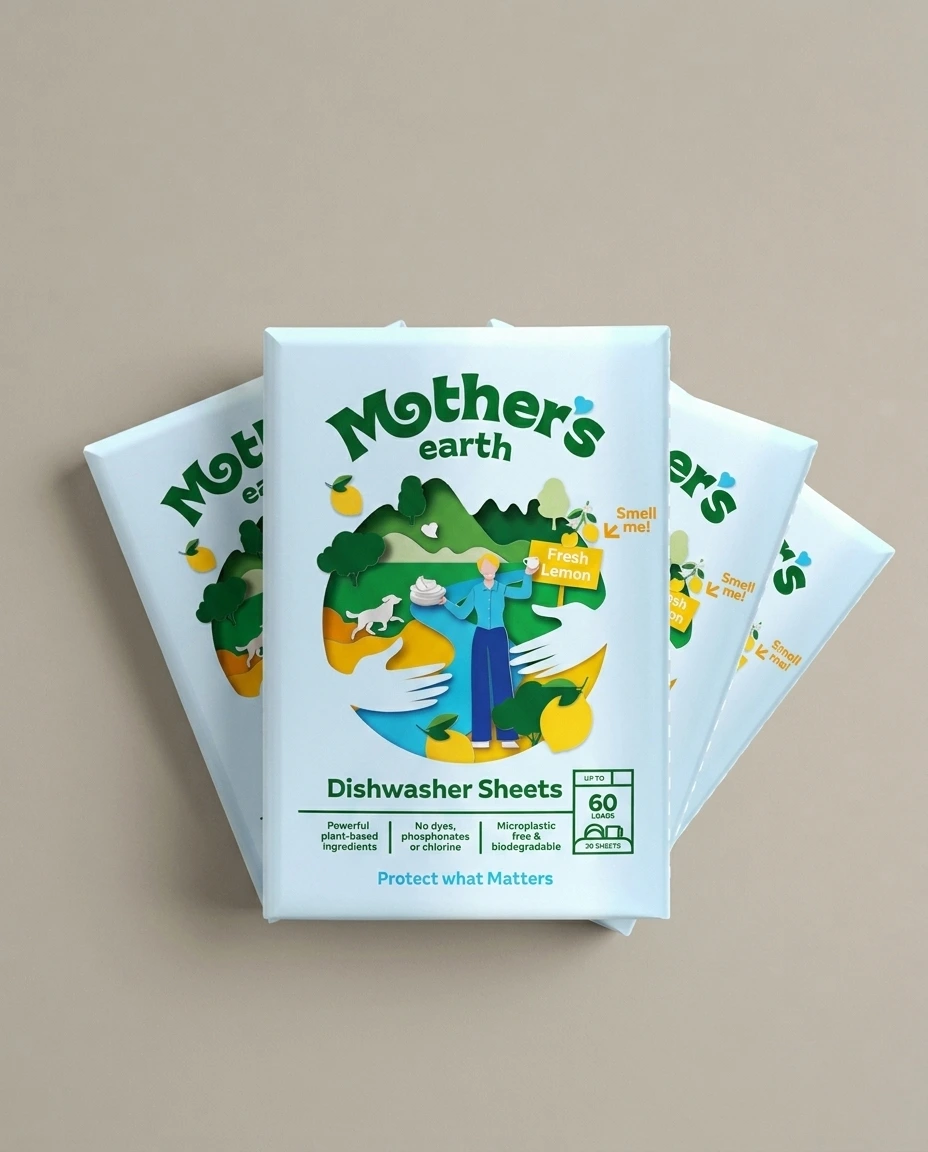
Mother’s Earth Dishwasher Sheets
Plant-based, plastic-free, and a genuinely better swap for every household using a dishwasher.
🌱 Plant-based formula — enzymes from coconut oil and corn starch
🚫 No phosphonates, chlorine, formaldehyde, or microplastics
📦 100% plastic-free packaging — recyclable cardboard
🧬 Biodegradable — certified to OECD 301B standard
💧 CO₂-compensated shipping — via Shopify, Mast Reforestation, and Grassroots Carbon
🐾 10 washes donated per order — to shelters and charities of your choice
✅ 35,000+ satisfied customers — 80% five-star reviews
🔁 30-day money-back guarantee, no questions asked
Mother’s Earth is a small Dutch family business, founded by a mother and son with a specific frustration: why should cleaning your dishes come with a side of chemicals, plastic, and a guilty conscience?
The answer they built is deceptively simple: a thin sheet of concentrated cleaning formula, wrapped in cardboard, that you drop into the detergent compartment of any dishwasher. It dissolves completely. It cleans powerfully. It costs less per wash than any of the major brands. And when it’s gone, there’s nothing left — no pod film drifting into a river, no plastic tub headed for landfill.
Their operation is run from a small warehouse in Hengelo, the Netherlands, and ships worldwide. CO₂ from that shipping is offset through certified reforestation and soil retention projects. And with every order, 10 washes are donated — in your name — to a charity partner of your choice: cat shelters, dog shelters, domestic abuse refuges, or wildlife reserves.
It’s a small company doing the maths correctly: if a product is going to touch every household every day, the cumulative impact of doing it better is enormous.
The Conscious Choice Summary
Packaging: fully plastic-free. The sheets arrive in recyclable cardboard. Nothing else.
Formula: plant-based surfactants derived from coconut oil and corn starch. No phosphonates, no chlorine, no formaldehyde, no optical brighteners, no colourants, no animal fats, no phthalates, no parabens.
Microplastics: independently tested and confirmed free from microplastics under the ECHA definition (EU Regulation 2023/2055). This is the EU’s own standard, not a marketing claim.
Biodegradability: all surfactants are biodegradable to the OECD 301B standard, meaning more than 60% breaks down within 28 days. This is independently verified, not self-declared.
Skin safety: dermatologically tested and suitable for normal skin. The fragrance-free variant carries the Sensitive Skin Quality Mark and is additionally approved for sensitive skin.
Shelf life: stored in a cool, dry place, the sheets last up to two years.
The Ingredients, Explained
Most cleaning brands hide their formula behind words like “surfactant blend” and “cleaning agent.” Mother’s Earth publishes theirs in full. Here’s what’s doing the work:
Protease is an enzyme that breaks down proteins; the kind of residue left by egg, meat, and dairy. It also adds shine to glassware. The source is plant-based.
α-Amylase is an enzyme that breaks down starch; pasta, rice, bread, and the dried-on porridge that defeats most tablets. Also plant-based.
Saponins are naturally occurring compounds (think soapwort and similar plants) that provide the foaming action and help lift grease and general food residue from surfaces.
Together, these three do what phosphates and chlorine used to do without the downstream consequences.
How It Compares
| Mother’s Earth | Finish | Sun | Dreft | |
|---|---|---|---|---|
| Plastic-free packaging | ✅ | ❌ | ❌ | ❌ |
| No harmful chemicals | ✅ | ❌ | ❌ | ❌ |
| Biodegradable | ✅ | ❌ | ❌ | ❌ |
| Donates to charities | ✅ | ❌ | ❌ | ❌ |
| Money-back guarantee | ✅ | ❌ | ❌ | ❌ |
What Real Customers Are Saying
“I was initially skeptical about how effective Mother’s Earth dishwasher sheets could be compared to traditional detergents, but they genuinely exceeded my expectations. They clean extremely well, save space, and offer an eco-friendly alternative — I’m very satisfied and would definitely recommend making the switch.” — Radmila S., verified buyer
“The product convinced me completely. After the wash cycle, there’s no chemical smell at all — that alone is a huge plus for me. What particularly impressed me is that even burnt-on residue in a casserole dish was removed without any problem.” — Stephan W., verified buyer (translated from German)
“No residue whatsoever on the dishes, glasses, or in the machine.” — Anonymous, verified buyer (translated from German)
“It feels great giving back to the environment. Just as good as having sparkling clean dishes.” — Jenny B., verified buyer
Based on 2,204 reviews, 80% are five stars. One honest note from the reviews: occasional dried-on yogurt or very thick dairy residue can leave a faint ring in deep bowls. For those items, a short pre-rinse before loading is worth the ten extra seconds.
How to Use Them
The learning curve is approximately zero.
- Load your dishwasher as normal.
- Take one sheet and place it in the detergent compartment — the same slot where a tablet would go.
- Close the compartment and run any cycle.
The sheet dissolves completely in water, including on cold cycles as low as 10°C. No pre-dissolving, no tearing, no measuring. The scent-free version leaves no fragrance on your dishes at all. The lemon version leaves a light, clean citrus note.
You do not need a separate rinse aid or salt when using these sheets — the formula handles it. If you want to optimise results further, you can add them, but it’s optional.
One sheet per wash. Store in a cool, dry place. Shelf life of two years.
The Donation Model
For every order you place, 10 washes are donated on your behalf for free to a charity partner of your choice. You can direct your donation to a cat shelter, a dog shelter, a refuge for women and children fleeing domestic abuse, or a wildlife reserve. The organisation receives actual product, not money; something shelters and refuges consistently cite as one of their most needed and least donated supplies.
It’s a small thing per order. Across 35,000+ customers, it adds up to something real.
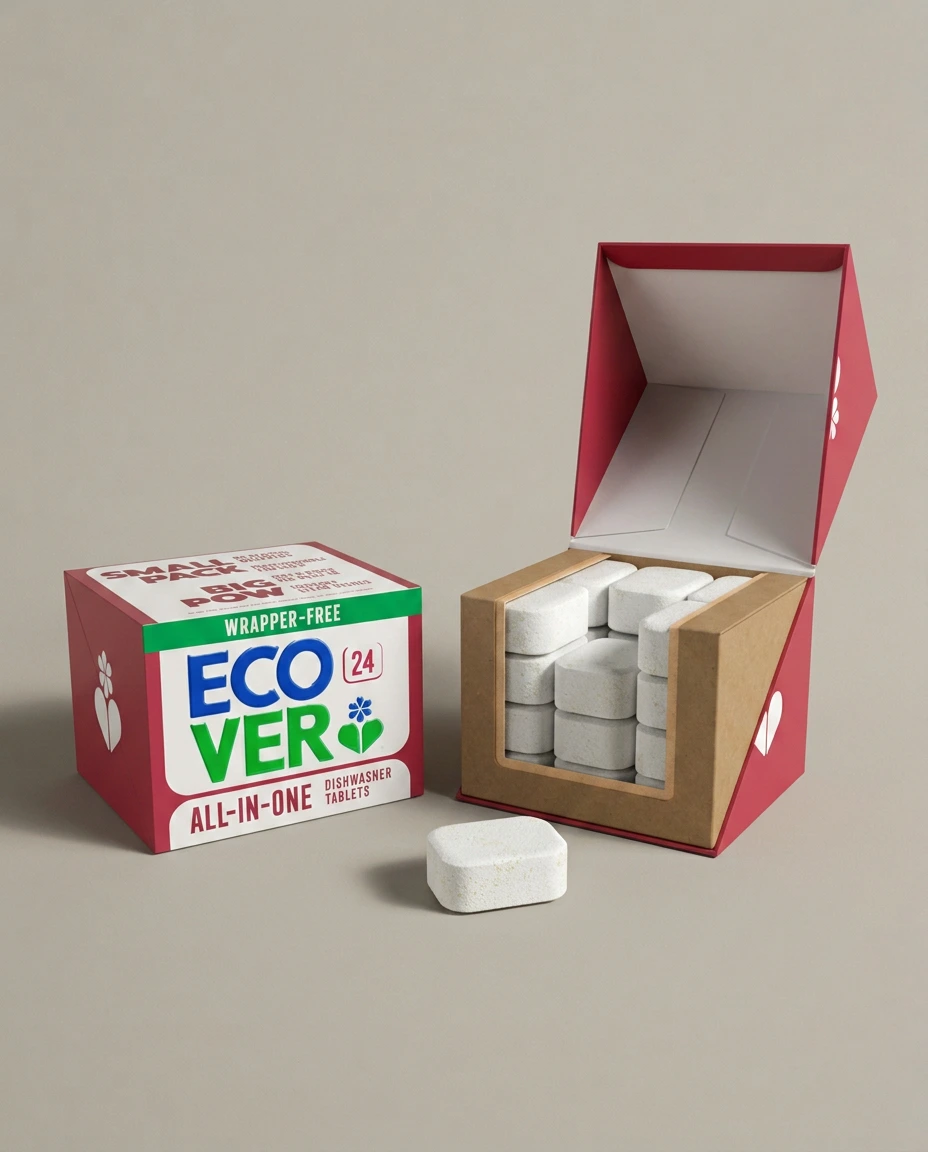
Ecover All-in-One Power Dishwasher Tablets
If you want a tablet rather than a sheet — something that feels more familiar in your hand — Ecover is the answer that doesn’t make you choose between cleaning power and a clean conscience.
🌱 Biodegradable formula — independently verified
🚫 No plastic wrappers — invisible plant-based coating instead of PVA film
📦 Recyclable cardboard packaging — minimum 60% post-consumer recycled
🧪 No parabens, chlorine, bleach, SLS, triclosan, phthalates, or microbeads
🧬 Vegan and cruelty-free — Leaping Bunny approved
🌍 Carbon offset — lifecycle emissions measured, reduced, and offset (Climate Impact Partners)
🍋 Mandarin and lemongrass scent — included rinse aid and salt action
💪 40% more enzymes (Power variant) vs. standard Ecover tablet
Ecover has been doing this since before “eco-friendly” was a marketing hook. They’re the world’s largest producer of ecological cleaning products, and they’ve been making their dishwasher tablets wrapper-free for years while the mainstream brands were still individually shrink-wrapping each pod in virgin plastic.
The tablet doesn’t come wrapped in anything you’d recognise as plastic. Instead, it uses an invisible coating that protects against breakage and moisture in transit, but isn’t the PVA film you find on conventional tablets, the kind that dissolves into waterways and never quite leaves. The cardboard box is made with a minimum of 60% post-consumer recycled material. Carbon emissions across the product’s lifecycle have been measured, reduced, and offset through Climate Impact Partners.
The formula is biodegradable, free from the usual list of offenders (chlorine, bleach, SLS, parabens, triclosan, phthalates, microbeads), and packs in rinse aid and salt action so you don’t need separate products. The Power variant adds 40% more enzymes compared to the standard Ecover tablet, which means better performance on the kind of baked-on residue that gets left behind when you run the eco cycle as intended.
One honest note: Ecover uses some palm oil derivatives in its formula, they state it comes from sustainable sources, but if palm oil is a dealbreaker for you, Mother’s Earth above is the cleaner alternative on that specific point.
Important Note on Ecover’s Ownership
We featured it because the products genuinely work, the packaging story is real, and the brand has a legitimate 45-year history of trying to make cleaning less toxic for the planet. That part hasn’t changed. What has changed is who’s cashing the check.
Since 2017, Ecover (and its sister brand Method) has been owned by SC Johnson, the privately held US household goods giant. SC Johnson doesn’t just own Ecover. It also owns Glade, Pledge, Windex, Shout, and Duck — a lineup of conventional, chemical-heavy cleaning brands that Ecover was founded, in part, to be the alternative to. That’s the awkward bit. Buying Ecover doesn’t mean SC Johnson has quietly gone green everywhere else. It means the company now sells the “eco option” and the “not-eco option” on the same shelf, and profits either way.
A few things worth knowing:
- SC Johnson tests on animals where legally required. Ecover itself remains Leaping Bunny certified, but Naturewatch Foundation pulled its endorsement over this exact link.
- Ecover and Method have both quietly vanished from the B Corp directory as of late 2025, with no public explanation.
- SC Johnson paid $2.25M to settle a lawsuit over Method’s “non-toxic” marketing claims.
- Independent ethics trackers flag SC Johnson for political donations, weak workers’ rights transparency, and tax-haven subsidiaries.
None of this means the formulas are bad; the product itself still holds up. It means the profits now also bankroll a parent company that undercuts the whole point. We’re keeping Ecover listed, but flagging this plainly. If a parent company’s animal testing or politics is a line for you, that’s a fair reason to look elsewhere. This is still a relatively better option, but more eco-friendly options exist, and choosing them is a better stance.
How It Compares to Mother’s Earth
If Mother’s Earth is the purer option (no palm derivatives, simpler plant-enzyme formula, Dutch family business donating washes to shelters), Ecover is the more familiar format for people who want something that looks and feels like a tablet, comes with rinse aid and salt action built in, and is available in most supermarkets and on Amazon.nl without a subscription. Both are meaningfully better than Finish, Sun, and Dreft. The choice between them comes down to format preference and how deep you want to go.
How to Use
Drop one tablet into the detergent dispenser. Don’t put it in the cutlery basket. If your water hardness is above 20°dH, add dishwasher salt separately. Eco mode is recommended for the best results — and yes, it actually works on eco mode.
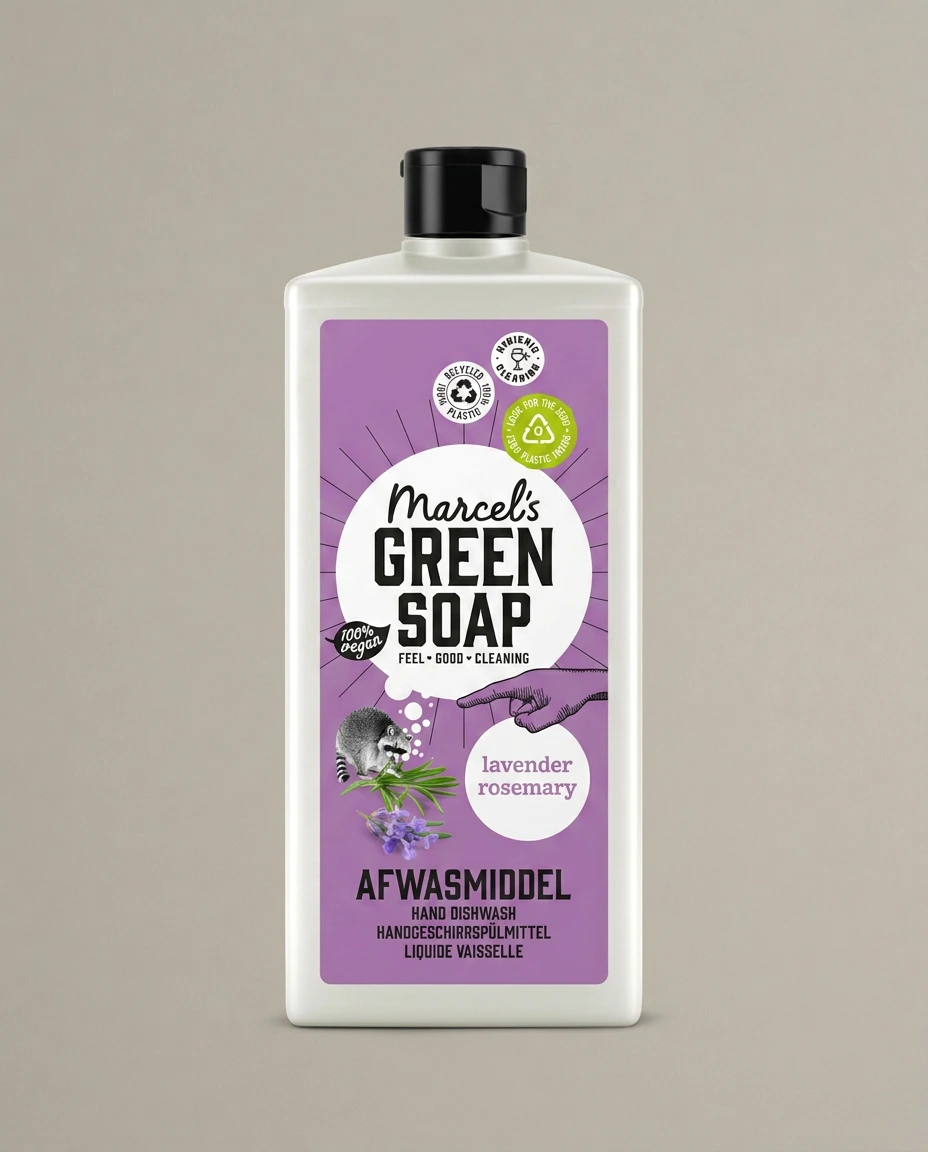
Marcel’s Green Soap Washing-Up Liquid
For the dishes that don’t go in the machine, and for everyone still doing the whole lot by hand, Marcel’s is the Dutch brand making plant-based washing-up liquid that doesn’t smell like it’s trying too hard.
🚫 Microplastic-free — certified under the ECHA definition (the EU’s own standard)
🧬 At least 97% biodegradable — verified to OECD guidelines
♻️ Bottle made from 100% recycled plastic — and refillable
💧 Refill system — saves 56% plastic vs. buying new bottles each time
🌱 Plant-based surfactants — vegan formula
🌸 Multiple scents — Orange & Jasmine, Lavender & Rosemary, and others
🫧 Soft foam — genuinely gentle on hands while cutting grease
Marcel’s Green Soap is one of those Dutch brands that somehow manages to be genuinely good-looking on the shelf, smell like something you’d actually want in your kitchen, and still tick most environmental box. The washing-up liquid is plant-based, microplastic-free under the EU’s own ECHA definition, at least 97% biodegradable to OECD standards, and comes in a bottle made from 100% recycled plastic.
The clever part is the refill system. You buy the bottle once. When it’s empty, you buy a refill pouch, which saves 56% of the plastic of buying a whole new bottle each time. This is one of those product designs that makes the sustainable choice the lazier choice, which is roughly the only way these things ever catch on at scale.
The formula uses plant-based surfactants, Sodium Laureth Sulfate and Cocamidopropyl Betaine, that produce rich foam and cut grease effectively while remaining gentle on skin. Marcel promises three things about every product: it smells good, it works, and it’s plant-based. The washing-up liquid delivers on all three without much drama.
The scent range is broad enough that you can pick one that actually suits your kitchen rather than tolerating something clinical. Orange & Jasmine is the most popular. Lavender & Rosemary exists for people who want to feel like they’re doing the dishes in a Provençal farmhouse.
One honest note: the bottle is made from recycled plastic rather than being entirely plastic-free. If that distinction matters to you, Marcel’s is the more responsible conventional option rather than a zero-plastic one. It’s still a substantial step up from any conventional washing-up liquid brand.
Why Hand-Washing Still Matters
Not everything goes in the dishwasher. Delicate glassware, wooden boards, non-stick pans, hand-painted ceramics, sharp knives, anything that technically fits but you know better than to trust to the machine. For those, you need something at the sink — and conventional washing-up liquids are quietly full of the same surfactants, synthetic fragrances, and preservatives that people are increasingly trying to avoid in other cleaning products.
Marcel’s is the answer that doesn’t require any compromise: it cleans, it foams, it smells good, and it costs roughly the same as whatever you’re currently buying.
How to Use
Squeeze a small amount onto a damp sponge or cloth, or directly into hot water for a basin wash. Rinse dishes with clean water after washing. Refill the bottle when empty using the Marcel’s refill pouches to reduce plastic waste.
Pairs well with: the Beewise loofah sponge below — same shelf, same values.
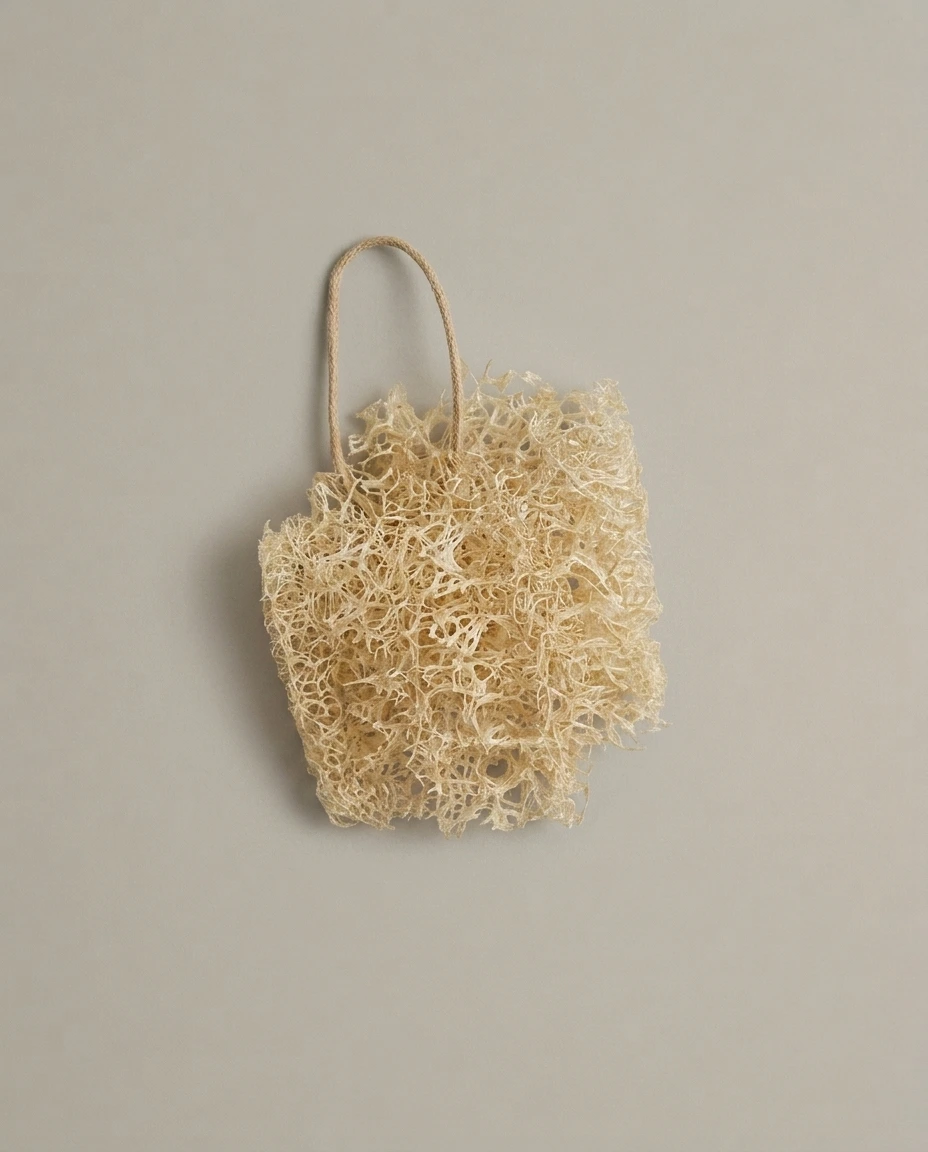
Beewise Loofah Dish Sponge
The conventional kitchen sponge is a small plastic brick slowly dissolving into your dishwater. The loofah is what kitchens used before plastic convinced everyone they needed something worse.
🌿 100% plant-based — grown from the Egyptian Luffa plant
🧽 Scratch-free — safe on non-stick surfaces and wine glasses
💧 Dries quickly — string-like fibre structure doesn’t hold water, preventing bacterial buildup
🪢 Cotton string included — for hanging to dry between uses
♻️ Fully compostable — goes in the green bin at the end of its life, not landfill
📦 Plastic-free shipping — Beewise reuses boxes and packing materials
🏙️ Dutch brand — Beewise is based in Amsterdam
Replace Your Synthetic Cleaning Sponge With A Biodegradable One
The conventional kitchen sponge is made from polyurethane or polyester foam. Every time you squeeze it under running water, tiny synthetic fibres detach and head down the drain straight into the water system, eventually into waterways, eventually into fish. Nobody designed it this way. It’s just what happens when you make a sponge out of plastic and then use it in water for weeks at a time.
The loofah is the older answer for eco-friendly dishwashing, and it’s better on every relevant metric except one: it requires a mild attitude adjustment, because it looks like something a 1970s health food shop would sell next to the wheatgrass tablets.
Get over that, and what you have is a dish sponge that’s grown from a plant (the Luffa, a relative of cucumber and gourd), contains no synthetic fibres, dries faster than any foam sponge because its natural structure doesn’t hold water, won’t scratch non-stick surfaces or glassware, produces rich lather with liquid soap, and at the end of its life can go directly into the compost bin.
The Beewise version uses Egyptian loofah specifically, considered the best variety for its thick fibres and the way it softens dramatically when wet without going to pieces. It comes with a cotton string for hanging, which matters more than it sounds: a sponge that dries between uses doesn’t harbour the same bacteria as one left sitting wet in a dish rack.
One honest note: a loofah sponge doesn’t last quite as long as a heavy-duty synthetic scrubber if you’re regularly attacking cast iron. For everyday dishes, glasses, and general washing up, it’s more than adequate. For brutal scrubbing jobs, pair it with a wooden brush.
The Numbers on Conventional Sponges
A 2017 study found that a single used kitchen sponge can harbour up to 54 billion bacteria per cubic centimetre. Conventional foam sponges retain moisture for days, creating ideal conditions for bacterial growth. The loofah’s rapid-drying fibre structure is a direct mechanical solution to this problem. It’s not a marketing claim; it’s physics.
How to Use
Wet the loofah thoroughly before first use and it will soften considerably. Apply your washing-up liquid directly to the loofah or to your dishes, scrub as normal, and rinse after use. Hang it by the cotton string to dry. When it’s at end of life (typically a few months with regular use), it can go into home compost. No microwave needed, no special treatment.
Pairs well with: Marcel’s Green Soap washing-up liquid above; one is the tool, the other is the product. Between them they cover everything that doesn’t go in the machine.
Our Verdict
Most households have the same setup: a plastic tub of tablets, a bottle of washing-up liquid in whatever was on offer, and a foam sponge that’s been sitting damp in the dish rack since last Tuesday. None of it is catastrophic. None of it is good.
The four products on this page replace each piece of that setup without asking you to scrub harder, spend more, or lower your standards on clean dishes.
Mother’s Earth is the one to start with if you have a dishwasher. The sheets clean well, cost less per wash than the supermarket brands, and leave behind absolutely nothing — no packaging, no chemical residue, no pod film drifting into a river. The 30-day money-back guarantee means you can run a full pack through your actual machine with your actual dishes and return it if it falls short. It won’t.
If you want a tablet rather than a sheet, Ecover covers you. Not as minimal as Mother’s Earth on every point, but a meaningful step up from anything on the Finish or Sun shelf, and available in most supermarkets without a subscription. One honest caveat: Ecover has been owned by SC Johnson since 2017. Yes, the same company behind Glade and Windex — so your euros are also, indirectly, funding a parent that doesn’t share Ecover’s standards on animal testing. The tablets themselves still perform and still beat the conventional shelf. Just know what you’re buying into.
For everything that doesn’t go in the machine, Marcel’s Green Soap does what good washing-up liquid should do without the synthetic fragrance, SLS overload, and single-use plastic bottle. The refill system is the detail that matters: you buy the bottle once.
The loofah is the swap most people are slowest to make, and the one that makes the most immediate physical sense once you do. Your current sponge is dissolving. Slowly, invisibly, into your dishwater and then into the drain. The loofah doesn’t do that, dries faster, and composts when it’s done.
None of these require compromise. That’s the only reason they’re on this page.
Shop Eco-Friendly Dishwashing Products
- Shop Mother’s Earth Dishwasher Sheets →
- Shop Ecover Dishwasher Tablets on Amazon.nl →
- Shop Marcel’s Green Soap on Amazon.nl →
- Shop Beewise Loofah Dish Sponge →
Green Goods Gallery earns a small commission if you purchase through these links, at no extra cost to you. We only feature brands we genuinely believe in.