
Eco-Friendly Laundry Detergent Sheets
Your laundry detergent is mostly water. You’re basically shipping water across the country in plastic. Mother’s Earth Eco-Friendly Laundry Sheets are plant-based, plastic-free, and a flat piece of paper that does a better job than the blue jug under your sink.
🌱 Plant-based formula — surfactants, enzymes, and glycerine from plant sources
🚫 No parabens, phosphates, phthalates, dyes, or chlorine bleach
📦 100% plastic-free packaging — recyclable and compostable kraft paper box
🧬 Biodegradable — certified to OECD 301B standard
💧 CO₂-compensated shipping — via Shopify, Mast Reforestation, and Grassroots Carbon
🐾 5 sheets donated per order — to shelters and charities of your choice
✅ 35,000+ satisfied customers — 4.3 stars across 11,000+ Trustpilot reviews
🔁 30-day money-back guarantee, no questions asked
The Problem with the Jug Under Your Sink
Open the laundry cupboard of almost any household, and you’ll find the same thing: a plastic bottle, aggressively coloured, roughly 70% water, wearing a label that says “concentrated.” Concentrated relative to what? Last year’s version of itself?
Conventional liquid detergent is a logistical absurdity. Water is manufactured at the factory, mixed with cleaning agents and synthetic fragrances, then poured into a single-use plastic bottle that will take centuries to break down, and then shipped across road networks to sit on a shelf near you. You buy it, pour it out carefully to avoid measuring too much, and eventually throw the bottle in a bin where, statistically, it has roughly a 9% chance of being recycled.
Then there are the chemicals themselves. Standard detergents contain petrochemical surfactants, synthetic optical brighteners that make clothes look clean under UV light without actually removing anything, artificial fragrances, bleaching agents, and preservatives, many of which end up in waterways after each wash cycle.
And pods aren’t the clean solution they appear to be either. Each one is individually wrapped in polyvinyl alcohol, a water-soluble polymer that dissolves in the machine but doesn’t biodegrade cleanly downstream.
The laundry industry has been selling you the same formula since the 1950s, rebranded every few years with a louder colour and a more optimistic word like “bio” or “sensitive.” The environmental cost of this is not small. Across Europe, hundreds of millions of plastic detergent bottles are discarded every year.
There is a better way. It weighs almost nothing and fits in a cardboard envelope.
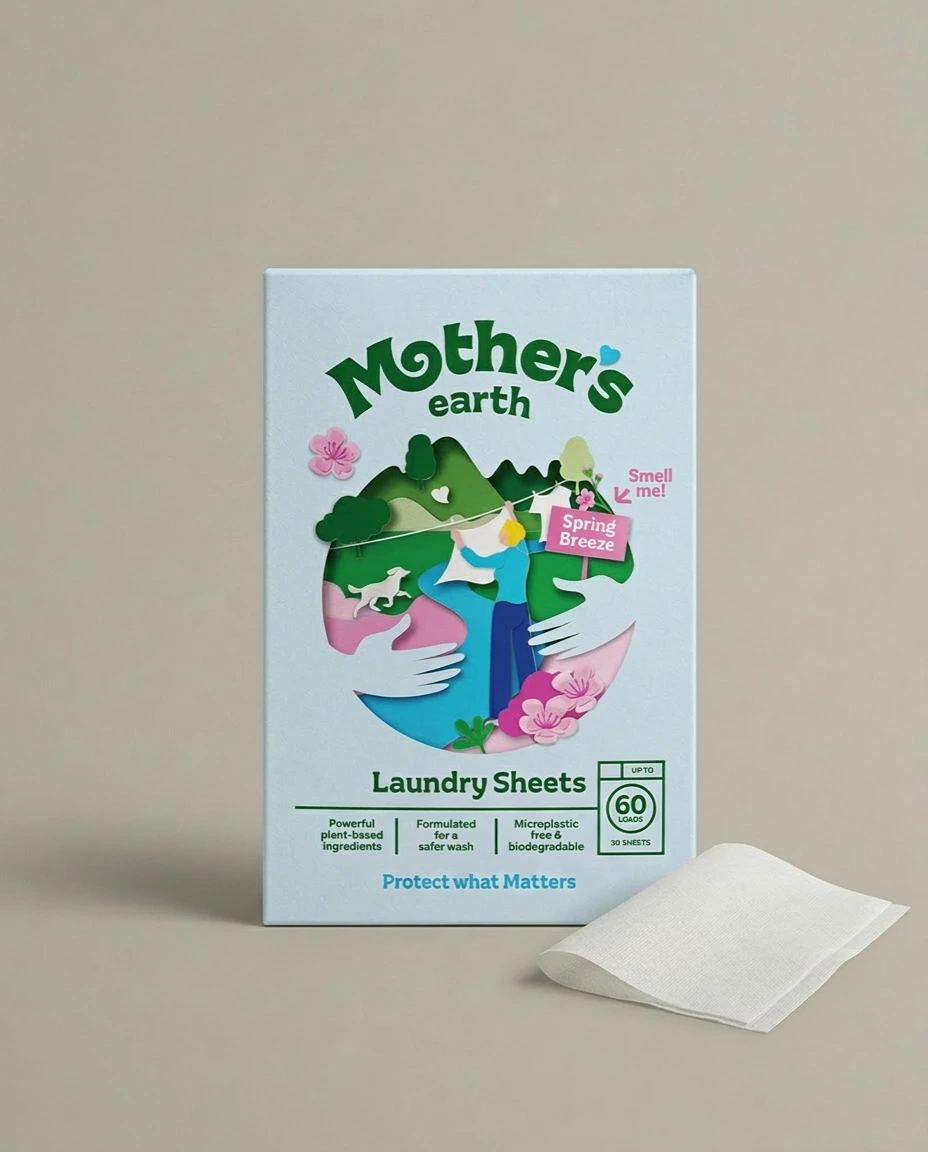
Mother’s Earth Laundry Detergent Sheets
Mother’s Earth is a small family business founded in the Netherlands by Lisette, done with large corporations not taking responsibility for the environmental impact of everyday cleaning products. The goal was direct: build something that actually cleans, contains no harmful chemistry, generates no plastic waste, and costs less than the brands it replaces.
Meet Mother’s Earth
What puts them in the credible column rather than just the well-intentioned one:
They publish every ingredient on their website with a plain-language explanation of what it does and why it’s in the formula. That’s rarer than it should be. They acknowledge the ongoing scientific discussion around polyvinyl alcohol (PVA), an ingredient in their laundry sheets, directly and without spin, and state they’re actively working on PVA-free alternatives. Their shipping is CO₂-compensated through verified partnerships. Their 30-day no-questions money-back guarantee is real, not a buried clause.
They operate out of Hengelo, the Netherlands, and ship worldwide. Their products are manufactured at scale and shipped from China — a supply chain reality they’re transparent about rather than hiding behind vague “sustainably sourced” language.
Over 11,000 Trustpilot reviews. 4.3 out of 5. Not paid, not curated.
The Conscious Choice Summary
Packaging: fully plastic-free. The sheets arrive in a kraft paper box that is both recyclable and compostable. Nothing else.
Formula: plant-based surfactant, plant-derived betaine, plant-derived glycerine, sodium citrate, starch, polyvinyl alcohol (PVA), and water. The scented version adds fragrance. The unscented version now includes Protease, a plant-based enzyme that breaks down protein-based stains.
Microplastics: the sheets contain PVA, which is not classified as a microplastic by ECHA under EU Regulation 2023/2055, as it dissolves in water rather than forming solid particles. However — and this matters — research indicates that around 75–77% of PVA survives conventional wastewater treatment plants in dissolved form. It doesn’t behave like a solid microplastic, but it doesn’t simply vanish either. Mother’s Earth addresses this on their ingredient page and is developing PVA-free alternatives. This is an honest trade-off: significantly better than billions of plastic bottles, but not a zero-impact solution. Anyone telling you otherwise is selling something harder than a laundry sheet.
Biodegradability: OECD 301B certified, meaning over 60% of the formula breaks down within 28 days under standard conditions.
Skin safety: hypoallergenic and free from parabens, bleach, dyes, and phosphates. The unscented version is suited to babies and people with fragrance sensitivities.
Shelf life: two years, stored in a cool, dry place.
Works in: all machine types — top-loading, front-loading, HE. Hot or cold water, 10–90°C.
Does not work on: wool and silk. The Protease enzyme in the unscented version breaks down protein fibres, which is exactly what you want on a grass stain and very much not what you want on a cashmere jumper. Keep those separate.
The Ingredients, Explained
Most detergent brands hide their formula behind “surfactant system” and “cleaning complex.” Mother’s Earth publishes theirs in full. Here’s what’s actually doing the work:
Plant-based surfactant is the main cleaning agent. Surfactants break the surface tension between water and grease, lifting dirt off fabric and carrying it into the rinse water. This one comes from plant sources rather than petroleum.
Betaine is a mild, plant-derived surfactant used alongside the primary one. It helps reduce foam without compromising cleaning power, and is gentle enough for sensitive skin. Often used in baby products for the same reason.
Glycerine is a plant-derived humectant — it attracts moisture. In a detergent, this means it infuses a small amount of moisture into fabric fibres, leaving clothes softer without the animal fats and synthetic polymers found in conventional fabric softener. No separate softener required.
Sodium citrate acts as a water softener. Hard water (common across the Netherlands, Belgium, and the UK) contains calcium and magnesium ions that interfere with surfactant performance. Sodium citrate neutralises them, allowing the surfactant to do its job properly rather than fighting the water itself.
Protease (unscented version only) is a plant-based enzyme that breaks down protein molecules — the kind that make up sweat, blood, food residue, and body oils. This is the ingredient that handles the actually difficult stains. It’s also the ingredient that makes wool and silk a no-go.
How It Compares to Conventional Detergent Brands
| Mother’s Earth | Ariel Pods | Persil Capsules | Robijn Caps | |
|---|---|---|---|---|
| Plastic-free packaging | ✅ | ❌ | ❌ | ❌ |
| No harmful chemicals | ✅ | ❌ | ❌ | ❌ |
| Biodegradable formula | ✅ | ❌ | ❌ | ❌ |
| Donates to charities | ✅ | ❌ | ❌ | ❌ |
| Money-back guarantee | ✅ | ❌ | ❌ | ❌ |
Mother Earth’s Laundry Sheets Reviews
“I am very content with the laundry sheets, the quality is good, they dissolve completely, and the laundry smells fresh and is clean after washing. I have less waste and feel better not to use so much plastic.” — TK Elbert, Trustpilot
“They clean very effectively, especially compared to other eco-friendly washing liquids. When dry, the clothes are so fluffy and have a subtle scent.” — Thespina E., Trustpilot
“Almost all detergents give my sensitive skin a rash but thankfully this one didn’t. Cleans well and super easy to use.” — Verified buyer, mothersearth.com
“Washing machine strips are maybe still a bit expensive, especially for hard water areas where more are needed.” — Patricia Aerts, Trustpilot
That last one is worth noting honestly: if you live in a hard water area, one sheet per wash may underperform. Two sheets, or an extra half, will fix it. The hard water note in the how-to section explains this. The point is: this is a dosage issue, not a product failure, and it’s something the brand should probably say louder on the packaging.
How to Use Mother Earth’s Laundry Sheets (and How to Actually Get Results)
The basics take about ten seconds to learn.
- Take one full sheet and place it in the drum on top of your laundry, or tear it into pieces and put it in the detergent drawer. Both work equally well.
- For a small or half load: tear off half a sheet along the perforation. That’s what it’s there for.
- Close the drawer or drum and run any normal cycle.
The sheet dissolves completely in water, including cold cycles. No foam is not a sign that it isn’t working. Foam is a marketing signal, not a cleaning signal. The detergent industry trained you to equate bubbles with results. It’s not accurate.
To get the best results:
- For heavy loads or heavily soiled laundry: use two sheets. One sheet is calibrated for a standard load. Overloading the machine or skipping the extra sheet and then being disappointed is a user error, not a product flaw.
- For hard water areas: use an extra half sheet. Hard water (most of the Netherlands, Belgium, and large parts of the UK) reduces surfactant effectiveness. The sodium citrate in the formula helps compensate, but high mineral content still blunts performance at the standard dose.
- For protein-based stains (sweat, blood, food): choose the unscented version with Protease. The scented version does not contain this enzyme. Pre-treating stubborn stains with a small piece of dampened sheet directly on the fabric before washing improves results.
- For everyday loads: the scented Fresh Linen version performs well at normal temperatures without any adjustment.
- For travel: one small cardboard box handles dozens of washes and fits in any bag without liquid restrictions, leaking risks, or embarrassing check-in moments.
Things not to do:
- Do not use on wool or silk — enzyme damage.
- Do not overload the machine and expect one sheet to compensate for physics.
- Do not judge results by foam level.
Pairs well with: Mother’s Earth Dishwasher Sheets — if you’re already cutting plastic out of the laundry room, the kitchen is the next logical step.
The Donation Model
With every purchase, Mother’s Earth donates five laundry sheets on your behalf for free to a charity partner of your choice. Current options include cat shelters, dog shelters, and refuges for women and children fleeing domestic violence.
The organisations receive actual product, not a promise. Shelters consistently cite cleaning supplies as among their most-needed and least-donated items. Five sheets per order is a small number per transaction; across 35,000+ customers, it adds up to something real.
You choose where your donation goes at checkout. It costs you nothing extra.
One More Thing: When You Wash Synthetic Clothing
The laundry sheets handle the detergent side of a cleaner wash. But if your machine regularly contains polyester, nylon, fleece, or any synthetic blend, there is a second problem the sheets cannot address: microplastic shedding.
Every wash of a synthetic garment releases tiny plastic fibres that pass through most wastewater treatment plants and enter waterways. A single wash of a fleece jacket can release more than 1,900 individual microfibres. The Guppyfriend Washing Bag captures 86% of them before they reach the drain, independently tested and patented, by placing your synthetic clothes inside it before loading the machine.
The two products work well together: the laundry sheets dissolve normally through the Guppyfriend’s mesh, and the combination means your synthetic wash is both plastic-free on the detergent side and microfiber-contained on the shedding side.
Our Verdict
Mother’s Earth laundry sheets solve a real problem: the outsized environmental cost of repeatedly shipping water in plastic into every household in the country. They replace that system with a sheet of concentrated formula in a cardboard box, and they do it at a price that’s competitive with conventional pods when you factor in the per-wash cost.
For everyday laundry, these work well. They dissolve completely, leave no residue, are gentle on sensitive skin, and produce no plastic waste. The brand is transparent in a market where transparency is not the default.
Two honest caveats that belong here rather than in the fine print: the PVA question is real and unsettled. These sheets are not a zero-impact product, though they are a meaningfully better one than what most households currently use. And on heavily soiled loads, they will not out-clean Ariel if you use one sheet in cold water. No laundry sheet brand will. That is a category limitation, and the how-to section addresses it with practical fixes.
Buy these if: your laundry is mostly everyday clothes, you’re done buying plastic bottles, you have sensitive skin, you travel, or you want a straightforward swap that is objectively better than the current alternative.
Consider twice if: you regularly wash heavily soiled workwear and want maximum stain-fighting power with no pre-treatment, or you wash a lot of wool and silk and need a single detergent for everything.
The 30-day money-back guarantee removes the financial risk. Try one pack. If it doesn’t work in your machine, with your water, on your laundry — get your money back. That offer is there because the brand is confident it usually doesn’t happen.
Ready to Make the Switch?
Plant-based. Plastic-free. No measuring. No spills. No jug. 30-day money-back guarantee.
Shop Mother’s Earth Laundry Sheets →
Green Goods Gallery earns a small commission if you purchase through this link, at no extra cost to you. We only feature brands we genuinely believe in.