


Sustainable and Reusable Coffee Cups That Make an Impact
The paper cup you just threw away was never recyclable. It just looked like it was. You’ll find three reusable coffee cups on this page. KeepCup Commuter for the long day out. KeepCup Brew Cork for the coffee you sit with. Beewise for the coffee you forgot to plan for. All three better than the bin. Zero reasons to use disposable cups. Switch to sustainable coffee cups today and make an impact.
The Paper Cup Is Not What You Think It Is
The takeaway coffee cup feels like a paper product. It looks like one. It is printed like one. Most people believe it is one and that it goes into the paper recycling along with everything else. It does not.
A disposable coffee cup is approximately 90–95% paper and 5% polyethylene, a thin but inseparable petroleum-derived plastic film bonded to the paper interior that prevents liquid from soaking through. Without this lining, the cup cannot hold a hot drink. With it, the cup cannot be processed by conventional paper recycling mills, which are not designed to separate plastic-paper laminates.
The result: less than 1% of disposable coffee cups are recycled worldwide. The recycling symbol on the side of the cup, when present, reflects a theoretical recyclability that requires specialist facilities that almost no municipality operates. According to Zero Waste Europe, around 16 billion disposable coffee cups are used annually in Europe, with most destined for landfill or incineration.
The plastic lining doesn’t just cause recycling problems; it causes health problems too. Research shows that the polyethylene lining begins to degrade within the 15 minutes it takes to finish a hot drink. Three hot beverages from a paper cup introduce approximately 75,000 microplastic particles into the drink and into you. For a daily coffee drinker, this adds up across a year of morning commutes into a number worth thinking about.
The Netherlands performs better than most at cup recycling, with an approximately 25% recycling rate, but that still means three in four cups end up as non-recyclable waste. The correct solution is not a better collection infrastructure. It is refusing disposable cups and using sustainable coffee cups.
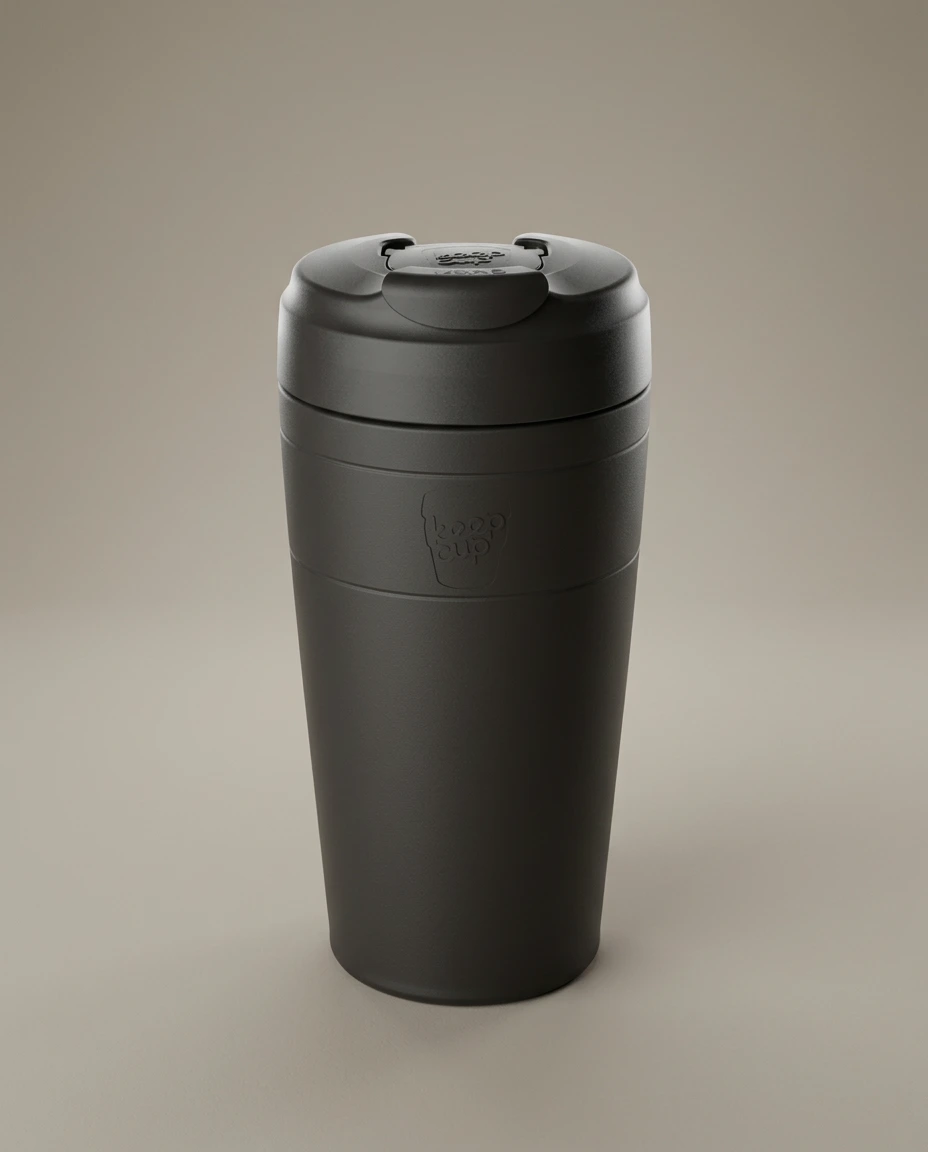
KeepCup Commuter
🔒 Fully sealed flip lid — locks closed; bag-safe, commute-safe, and carry-upside-down-safe
🌡️ Double-wall vacuum insulation — keeps drinks hot for hours, not under an hour; survives a long commute and a travel day
🚗 Fits standard car cup holders — designed for actual daily use, not just café counters
⚙️ Electropolished 18/8 stainless steel — durable, flavour-neutral, no plastic contact with your drink
🌍 B Corp certified since 2014 — one of Australia’s founding B Corps; 1% of global revenue donated to environmental causes via 1% for the Planet
📊 LCA-verified breakeven at 66 uses — independent lifecycle analysis by Edge Environment; higher than the Brew Cork because more material goes into making it, but still a net positive within months of regular use
♻️ Separable, single-material components — designed to be taken apart for recycling at the end of life
Why KeepCup Commuter Is on This Page
KeepCup was founded in 2009 in Melbourne by siblings Abigail and Jamie Forsyth, who ran a café and watched the volume of disposable cups pile up daily. The brief was specific: build a reusable cup that worked in a real café environment, small enough to fit under an espresso machine, functional enough that baristas would actually accept it. The result was the world’s first barista-standard reusable cup.
The lid locks closed. Not just splash-proof. You can put a full Commuter into a bag, turn the bag upside down, and the coffee stays where you left it. For anyone who has lost a cup of coffee to a bag lining, or who commutes by bike, or who travels regularly and needs a cup that survives actual movement, this matters more than anything else on the spec sheet.
The insulation is double-wall vacuum, not single-wall. This is the difference between coffee that is still hot when you get off the train and coffee that is lukewarm by the time you find a seat. The Commuter is for long days out, not for sitting at a desk within arm’s reach of a kettle.
The body is electropolished 18/8 stainless steel. Electropolishing is a finishing process that removes surface irregularities at a microscopic level, producing a smoother, more hygienic interior that resists staining, does not retain flavour, and does not corrode. Your coffee tastes like coffee.
KeepCup is B Corp certified since 2014, when they became one of Australia’s founding B Corps. They are also a member of 1% for the Planet, donating at least 1% of global revenue to environmental causes, and a Living Wage employer. These are structural commitments, not marketing copy added to a product page.
The sustainability credentials have been independently verified. KeepCup commissioned sustainability consultancy Edge Environment to conduct ISO compliant lifecycle analyses covering manufacturing, packaging, shipping, use, and end of life. The Commuter breaks even with single-use cups after 66 uses. The higher breakeven compared to the Brew Cork below reflects the greater material input required to make it. After that, every use is a net positive.
Honest Caveats: KeepCup Commuter
It costs more and weighs more than the Brew Cork (see below). Stainless steel vacuum-insulated construction is heavier than glass, and priced accordingly. If your routine is desk-to-café-and-back and you do not need the sealed lid or extended heat retention, the Brew Cork does the same environmental job for less money and less weight.
Handwashing is recommended. The Commuter is technically dishwasher-safe, but KeepCup recommends handwashing to preserve the surface finish over time. This is not a significant ask; a rinse and a soapy wash take under a minute, but worth knowing if dishwasher-only is your requirement.
The breakeven is 66 uses, not 24. More material went into making this cup, so it takes longer to pay back its manufacturing footprint. 66 uses is still roughly three months of daily weekday coffee, after which every use is a net environmental positive. This is not a reason not to buy it; it is a reason to actually use it.
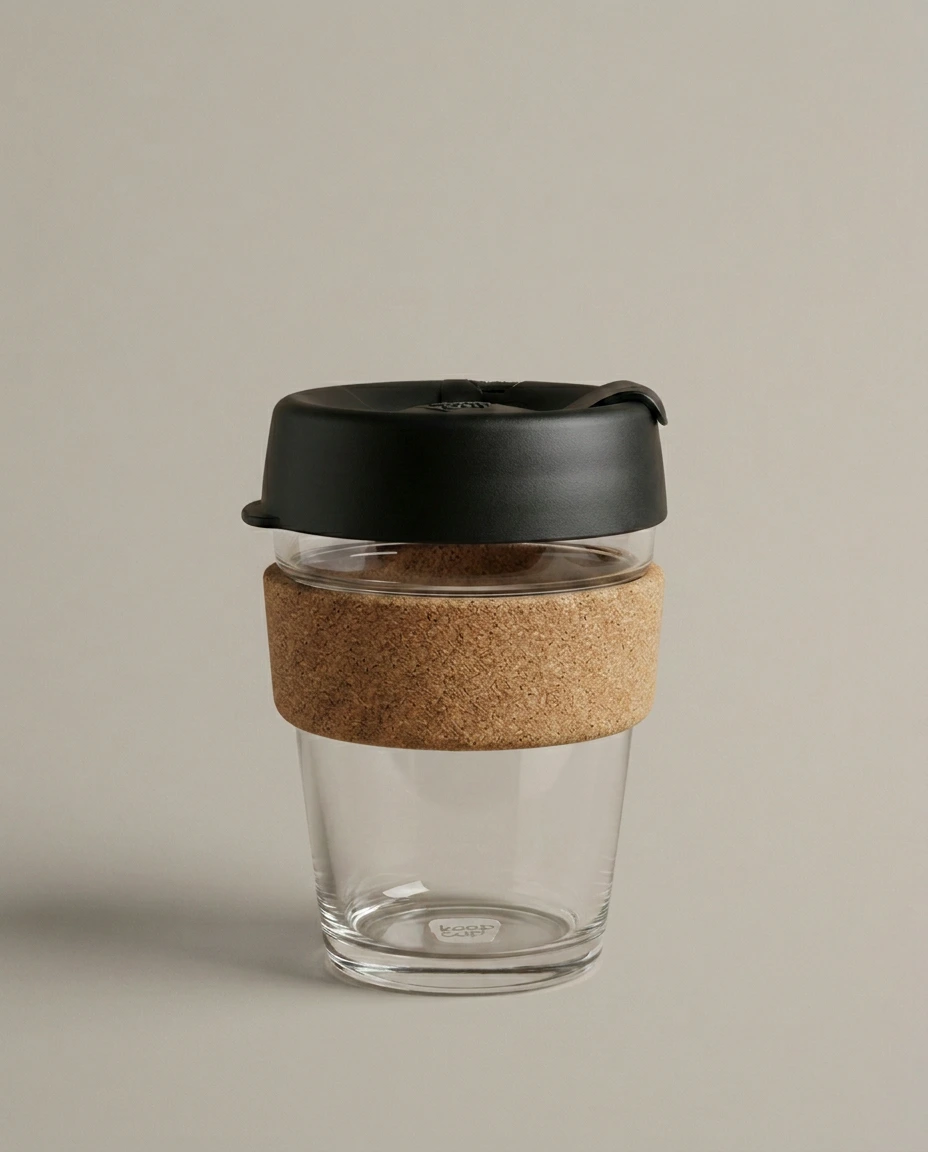
KeepCup Brew Cork
☕ Barista-standard design — fits under espresso machine group heads; no awkward manoeuvring at the counter
🥃 Tempered soda-lime glass — independently tested annually; lead and cadmium free; safe for hot and cold drinks up to 100°C
🍷 Natural cork band — sustainably sourced in Portugal from wine industry by-products; provides grip and partial heat insulation for your hand
🌍 B Corp certified since 2014 — one of Australia’s founding B Corps; 1% of global revenue donated to environmental causes via 1% for the Planet
📊 LCA-verified breakeven at 24 uses — independent lifecycle analysis by Edge Environment confirms the Brew pays back its manufacturing impact in roughly five weeks of daily weekday use
♻️ Separable, single-material components — designed to be taken apart for recycling at the end of life
Why KeepCup Brew Cork Is on This Page
A lot of reusable coffee cups are technically reusable but awkward to use, too tall, wrong diameter, lids that require the barista to remove and hold while they pour. The KeepCup was designed from inside the workflow, and it shows.
The cork band is not a decorative choice. Cork is sustainably sourced in Portugal and repurposed from wine industry by-products, a recovered material that would otherwise be waste. KeepCup independently tests its glass annually to confirm it is tempered to standard and is lead and cadmium-free.
This is a brand that has been doing the actual work since 2009. It is not the cheapest cup on the market, and it is not trying to be.
Honest Caveats: KeepCup Brew Cork
The glass breaks. Tempered glass is meaningfully tougher than ordinary glass. It can withstand temperatures up to 100°C and is more resistant to thermal and mechanical shock, and beads rather than shards when it does break. But it is not unbreakable. Drop it on tiles, and it may not survive. If you work in a physically demanding environment, commute by bike on cobblestones, or have a track record with glassware, look at the Commuter instead.
The lid is splash-proof, not leakproof. The press-fit lid is designed for the walk from café counter to desk; it is not leak-proof or spill-resistant. Do not carry a full cup upside down in a bag. Carry it upright. This is fine for most real-world use cases, but worth knowing before you buy.
Heat retention is limited. The glass body does not insulate. Heat retention is under an hour. Less if the ambient temperature is cold. The KeepCup Brew Cork is for drinking, not for keeping coffee warm on a four-hour train journey.
The cork band means hand-wash only. The cork band is non-removable, which means this cup is neither microwavable nor dishwasher-safe. Rinsing after each use and a soapy wash once a week is fully sufficient, as the glass and lid both clean easily, but if dishwasher compatibility is non-negotiable, choose the Brew Glass with a silicone band instead.
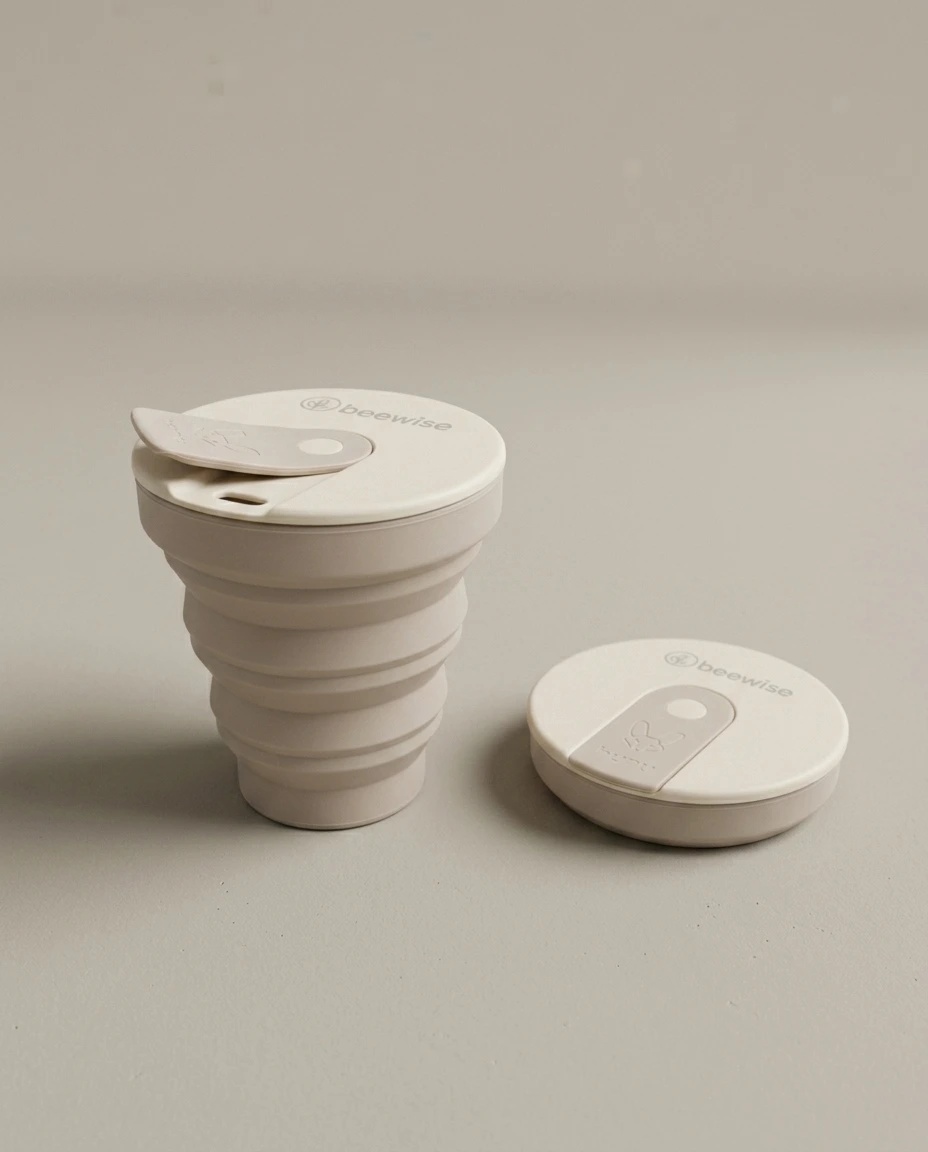
Beewise Collapsible Cup
🥤 Food-grade BPA-free silicone — non-toxic, safe for hot and cold drinks
📐 Folds flat to 2.5cm — fits in a jacket pocket, handbag side pocket, or attached to a bag loop
☕ 235ml and 355ml — espresso-to-large-coffee range; 355ml covers most standard takeaway cup sizes
💧 Leak-proof lid included — carry it in your bag without stress
🧼 Dishwasher safe — also microwave safe without the lid; freezer safe
🌡️ Hot and cold drinks — and ice cream, technically, though that’s your business
🤝 In partnership with Hunu — Beewise sources this cup from Hunu, a specialist collapsible cup brand with an established design
📦 Ships plastic-free from Amsterdam — Beewise reuses boxes and packing materials across all orders
What the Collapsible Cup Actually Is
The Beewise collapsible cup is sourced in partnership with Hunu, a specialist collapsible cup brand with a product specifically designed around two problems: performance and portability. Beewise sells it because it matches their plastic-free, Amsterdam-shipped product ethos; Hunu makes it because collapsible cups are what they do.
The material is food-grade silicone the same material used in kitchen bakeware, infant products, and medical devices. It is inherently BPA-free because silicone is not a plastic: it is a polymer of silicon and oxygen, derived from quartz sand rather than petroleum. It does not leach compounds into hot liquids, does not absorb food odours, does not stain, and does not degrade with heat cycles the way plastic does.
The collapsible mechanism is a concertina-fold structure. The cup compresses by pressing the base upward, collapsing the silicone walls in on themselves until the cup is 2.5cm tall. At 355ml expanded, it is the height of a standard coffee cup. At 2.5cm closed, it is the height of a thick coin stack. The lid stays on during transport in either state.
The lid is a flat snap-fit cap that seals the cup sufficiently for bag transport without leaking. It is not rated for vigorous movement or inverted carrying. If you need to walk at a pace with a full cup, carry it upright.
Sizes: 235ml covers espresso, cortado, flat white, or a smaller Americano. 355ml covers a standard medium latte, cappuccino, or filter coffee, the size most takeaway cups fall into.
The Silicone Smell Said Clearly
New food-grade silicone products sometimes have a faint manufacturing odour. Beewise customer reviews are mixed on this specific cup: some report no smell at all from the moment of unboxing; others notice a mild silicone scent on first use. In all documented cases, it resolves after one or two washes.
Before first use: wash with warm water and mild soap, rinse thoroughly, and allow to air dry completely. This removes any residual manufacturing scent and confirms the cup is clean. Most users report the smell is gone entirely after this step.
This is a characteristic of food-grade silicone across all brands and product types, not specific to this cup. It is harmless; food-grade silicone is inert and does not leach at temperatures up to 200°C, but worth knowing before you order.
How to Use It
Getting a coffee to go: unfold the cup, open the lid, and hand it to the barista. Most coffee shops accept reusable cups; under the EU Single-Use Plastics Directive, many are now required to offer a discount for doing so. Ask — it is increasingly common.
At the office: keep it at your desk, expanded or folded, fill from the kitchen, fold and pocket when done. The silicone does not retain heat the way a ceramic mug does, so it is not the ideal vessel if you want your coffee hot an hour later. It is a takeaway cup replacement, not a thermos.
Washing: dishwasher safe — place it open-side down on the top rack. Alternatively, rinse with warm soapy water, which takes thirty seconds and is fully sufficient for daily use. The concertina structure opens fully enough to be cleaned by hand without tools.
Microwave: safe without the lid. The silicone body handles microwave heat without any issue; the lid is not rated for microwave use and should be removed first.
Freezer: safe. The silicone is flexible at low temperatures and will not crack or deform.
What Real Customers Say
“It’s great!! I have no idea why other people mention some smell, mine smelled very neutral even before washing it. Overall, a very practical thing, I’m a big fan!” — Tamara M., verified Beewise customer
“Super practical, I take it everywhere.” — Clara, verified Beewise customer
The most consistent theme across reviews is the practicality of the collapsed size. The primary reason people do not use reusable cups is not values, it is that they forget to bring one, or it takes too much space to keep it with them. A cup that folds to the size of a thick coin removes that objection. You do not need to plan around it. It is simply there when you need it.
Our Verdict
The disposable coffee cup is one of the most persistent greenwashing stories in consumer packaging: paper on the outside, invisible plastic lining on the inside, recycling symbol on the sleeve, and less than 1% of them ever actually recycled. Switching to a reusable cup is the only intervention that actually solves the problem.
The three cups on this page solve it in different ways, for different people.
The KeepCup Commuter is for when leaks, heat retention, and long days out are the problem. Fully sealed, vacuum-insulated, bag-safe, fits a car cup holder. More expensive and heavier than the Brew Cork, and worth it if your routine demands it.
The KeepCup Brew Cork is the everyday desk cup. Tempered glass, natural cork band, barista-standard sizing, and a brand that has been doing the actual work since 2009. It sits on your desk, goes to the coffee shop, and does not ask much of you beyond remembering to bring it. Which, for most people, is enough.
The Beewise solves the one reason most reusable cups stay at home: they are too bulky to carry casually. A cup that folds to 2.5cm and lives permanently in a jacket pocket is a fundamentally different proposition from a ceramic mug you have to plan around. Food-grade silicone, dishwasher-safe, available in two sizes. The lid holds, the silicone is safe and inert, and the collapsed size is genuinely small enough that not having it is a choice rather than a logistical limitation.
Switching to sustainable coffee cups is essential. Any of the three options beats the bin. Pick the one that fits your life and actually use it. That is the full instruction set.
Shop Sustainable Reusable Coffee Cups
The Commuter is for travel and longer days out. The Brew Cork is the everyday desk cup. The Beewise collapses to 2.5cm and lives in your pocket for everything else.
- Shop the KeepCup Commuter on Amazon NL →
- Shop the KeepCup Brew Cork on Amazon NL →
- Shop the Beewise Collapsible Cup →
Green Goods Gallery earns a small commission if you purchase through these links, at no extra cost to you. We only feature products we genuinely believe in.