

Reusable Makeup Remover Pads Made of 100% Organic Cotton
You’re throwing away cotton pads every day. Each one took 100 litres of water to make, and that’s before the pesticides. Discover Beewise organic cotton makeup remover pads — reusable for hundreds of washes, plastic-free, and the simplest swap in your skincare routine.
🌿 Certified organic cotton — no pesticide residues, no synthetic fibres, no blends
🔁 Reusable for hundreds of washes — machine washable in the included mesh bag
📐 12 pads × 8cm diameter — standard size, suitable for all makeup types and skincare applications
🧺 Cotton mesh wash bag included — keeps pads together in the machine, prevents loss or tangling
📦 Plastic-free packaging — Beewise ships all orders without plastic
🚫 No synthetic fibres — fully biodegradable at the end of life
💶 Cost-effective over time — one set replaces months of disposable pad purchases
🛒 Free shipping within the Netherlands on orders over €50 and over €90 in Europe
The Science Behind The Cotton Pad You Throw Away
Single-use cotton pads are one of the highest-frequency waste items in a daily skincare routine, used once, discarded, and rarely thought about. The environmental cost sits largely upstream, in how the cotton is grown.
According to the United Nations Environment Programme (UNEP), conventional cotton cultivation occupies just 2.5% of the world’s arable land but consumes 200,000 tonnes of pesticides and 8 million tonnes of synthetic fertilisers annually. Cotton accounts for 4.7% of global pesticide sales and 10% of global insecticide sales, a disproportionate chemical load for a single crop.
The WWF estimates that producing a single cotton T-shirt requires around 2,700 litres of water. A pack of 100 cotton pads uses considerably less cotton than a T-shirt, but the arithmetic of daily use across millions of people adds up quickly.
Most single-use cotton pads are also not 100% cotton. They typically combine cotton fibres with polyester or viscose, which means they do not biodegrade, cannot be composted, and are not accepted in most recycling streams. They go into the general waste.
Switching to a reusable organic cotton pad does two things: it eliminates the daily disposal stream entirely and replaces conventionally farmed cotton (used once) with certified organic cotton (used hundreds of times). Both matter, and the second one compounds over time.
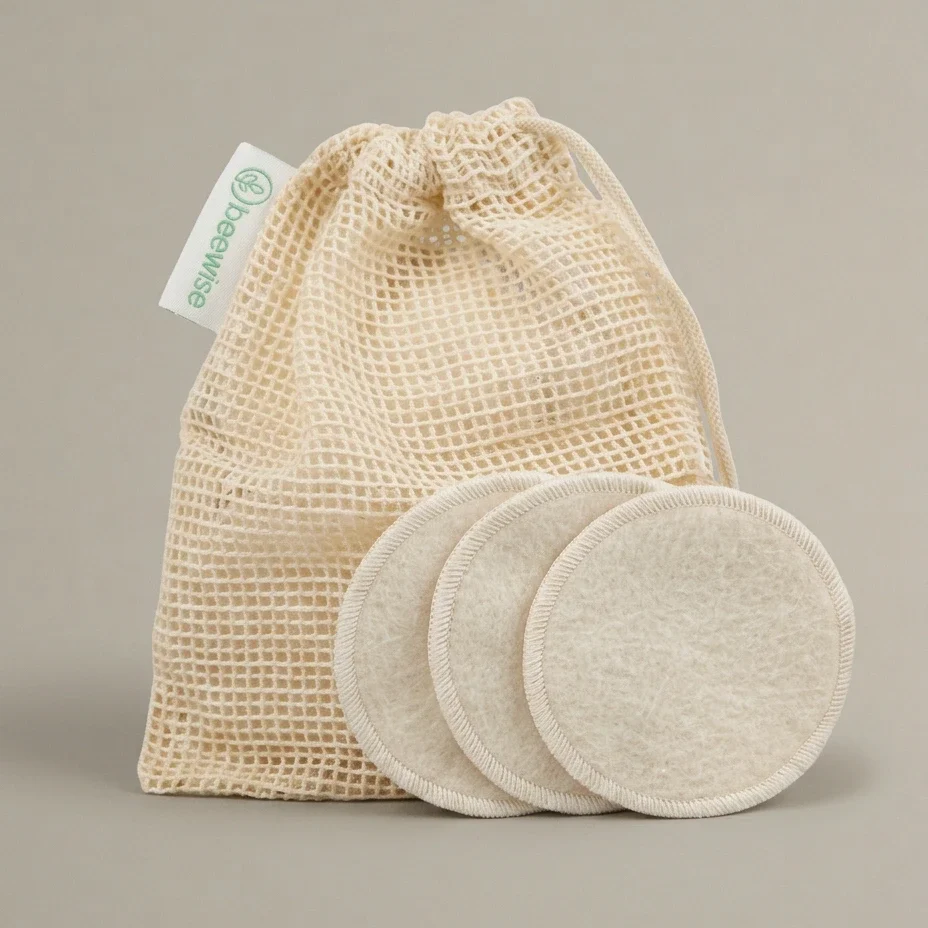
Beewise Reusable Makeup Remover Pads
12 pads × 8cm diameter + cotton mesh wash bag. Certified organic cotton. Plastic-free packaging.
What It Actually Is
A set of twelve round pads, 8cm in diameter, made from certified organic cotton, soft enough for daily face contact, robust enough to withstand repeated machine washing without losing shape or softness. The mesh bag keeps them together during the wash cycle and serves as storage between uses.
Organic cotton certification means the raw cotton was grown without synthetic pesticides, herbicides, or genetically modified seed varieties, and that the processing into finished fabric meets standards for chemical treatment. The absence of synthetic fibres means the pads break down naturally at the end of their working life, unlike conventional cotton-polyester blends.
The 8cm diameter is a practical size: large enough for full-face use in one or two wipes, easy to handle when wet and saturated with micellar water or cleanser, and compact enough not to waste product with oversized surface area.
What the Pads Work With
Micellar water, cleansing oils, balms, toners, serums, essence application, and any standard facial cleanser or makeup remover. Works with all makeup, including foundation, mascara, eyeliner, and lipstick; the organic cotton absorbs and holds product well without requiring excessive pressure on the skin.
For waterproof makeup: apply your remover product, hold the pad against the area for 20–30 seconds before wiping, the same technique used with any pad, disposable or reusable.
How to Use and Care
Daily: Use exactly as you would a disposable pad. Apply cleanser or micellar water, wipe, rinse under running water after use, and hang or lay flat to dry. Rinsing immediately after use prevents makeup from setting into the fibres.
Washing: Machine wash inside the included mesh bag at 30–40°C with your regular laundry. Do not use fabric softener. It coats the cotton fibres and reduces absorbency over time. Tumble dry on low or hang dry. The pads can also be washed by hand with mild soap.
Staining: Organic cotton absorbs well and will stain over time, particularly from mascara and heavy foundation. This does not affect function. For stubborn stains, apply a small amount of unscented soap directly to the pad before washing. Pre-soaking in cold water for 15 minutes also helps with fresh stains. The pads will not look pristine after months of use — that is the correct appearance of something being used properly rather than thrown away.
End of life: When pads eventually thin or lose their structure, cut them into pieces and add them to home compost or organic waste. No synthetic components, nothing that doesn’t biodegrade.
Meet Beewise Amsterdam
Already featured across several pages on this site, Beewise was founded in Amsterdam by Carina, who decided the absence of accessible plastic-free everyday products was a problem worth solving directly. Every Beewise product ships plastic-free, reusing boxes and packing materials across orders. Their makeup remover pads are sold in over 130 stores across 15 European countries.
Beewise Reusable Makeup Remover Pads Reviews
“Very soft material, good price, and great option to minimise single-use waste. Highly recommend.” — Verified buyer, Beewise Amsterdam
“These are genuinely as soft as a disposable pad — I was expecting them to feel rougher. They clean just as well and I haven’t needed to buy disposable pads in four months.” — Verified buyer
“The mesh bag is a great touch. I throw the whole bag in with my regular laundry and they come out clean. Simple.” — Verified buyer, Beewise Amsterdam
One honest note: as mentioned above, staining is normal and inevitable with regular use. Several reviewers note this as a surprise when it happens. It is not a quality issue.It is a cotton product doing its job and showing the evidence of it. The functional life of the pads extends well beyond when they start looking used.
The Cost Comparison
A standard pack of 100 disposable cotton pads costs approximately €2–3. At one to two pads per day, a regular user goes through three to four packs per year — roughly €8–12 annually. Over five years: €40–60, plus the environmental cost of 1,500–3,000 individual cotton pads going to waste.
One set of Beewise pads, washed and reused over the same period, costs a fraction of that and generates no ongoing waste. The mesh bag keeps the pads contained in the machine; the organic cotton holds up across hundreds of wash cycles. The upfront cost pays for itself within weeks.
Our Verdict
The reusable makeup pad is one of the simplest swaps on this entire site. It requires no technique change, no new routine, no adjustment period. You pick it up the same way, use it the same way, and wash it instead of binning it.
The Beewise version does this correctly: certified organic cotton rather than a conventional-cotton or synthetic-blend alternative, plastic-free packaging, a sensible size, and a mesh bag that removes the friction of washing.
The only reason to keep buying disposable cotton pads is not having thought about it. This page is that thought.
Shop Beewise Reusable Makeup Remover Pads
Standard set — 12 pads + mesh bag →
Green Goods Gallery earns a small commission if you purchase through these links, at no extra cost to you. We only feature products we genuinely believe in.