

Eco-Friendly Cleaning Cloths, Sponges & Brushes: Plastic-Free
The stuff you clean with is probably made of plastic. You’re washing dishes with fossil fuel. Three things to replace the synthetic sponge, the microfibre cloth, and the plastic dish brush sitting next to your sink right now.
The Problem With What’s Next to Your Sink
Walk up to a typical European kitchen sink and describe what you find. A sponge that is approximately 60–90% polyurethane foam and polyester, petroleum derivatives that shed microplastics into your washing water, live long enough to accumulate bacteria in their synthetic interior, and take decades to break down in landfills. A microfibre cloth that is also made of plastic, polyester, or polyamide fibres that release hundreds of thousands of synthetic particles every time it’s washed. A plastic dish brush that gets thrown out when the bristles give.
None of these things need to exist in their current form. They are the cleaning industry’s default because they are cheap to produce, not because they are the best available option.
The alternative is straightforward: replace the synthetic foam with plant fibre. Replace the polyester cloth with wood pulp and cotton. Replace the plastic brush with FSC wood and agave. The products do not cost more. They do not perform worse for everyday use. When they’re finished, they break down into compost instead of microplastics.
That is the swap this page is about.
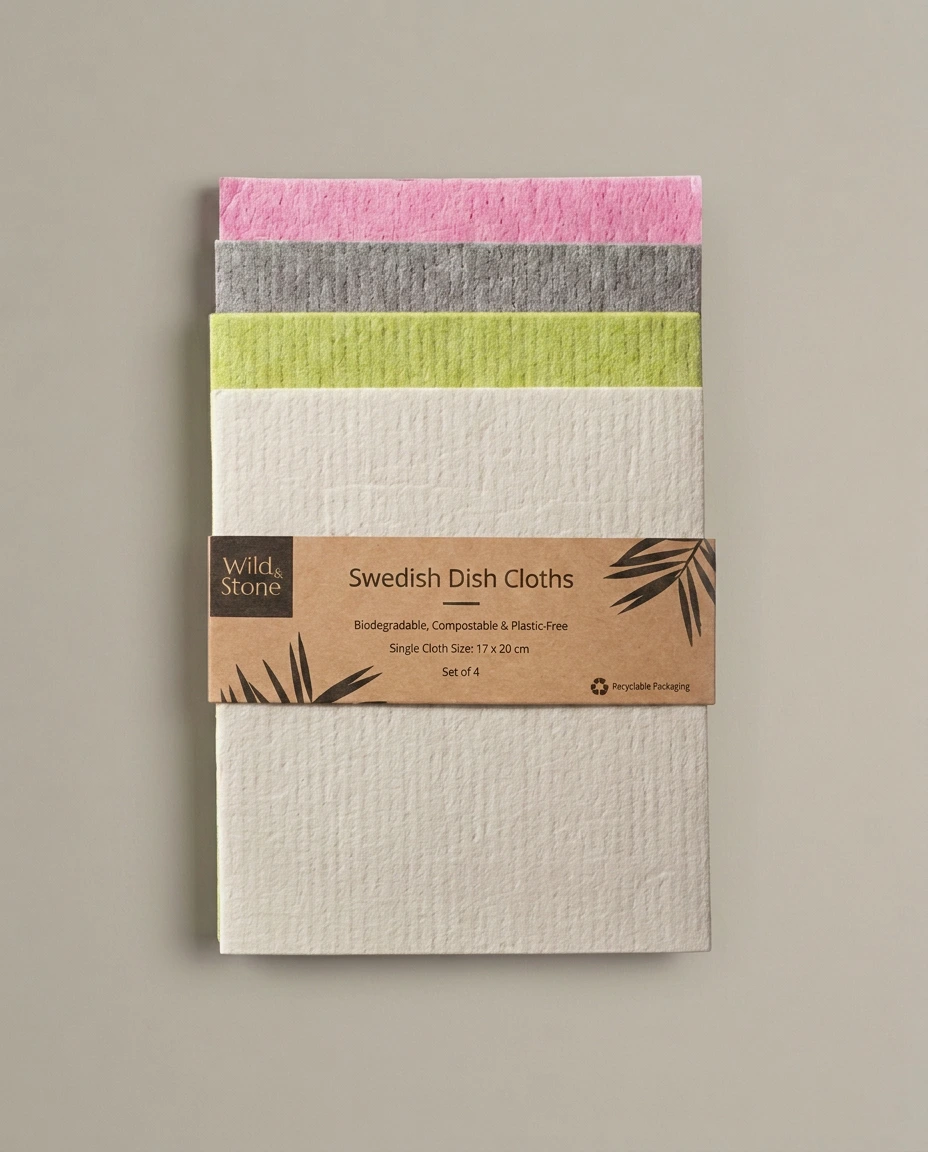
Product 1: Wild & Stone Swedish Dishcloth
The cloth/sponge hybrid that dries faster than a sponge, absorbs more than a paper towel, and composts when it’s done.
🌳 70% FSC-certified wood cellulose + 30% waste cotton — no synthetics, no plastic
♻️ Replaces up to 17 rolls of paper towels per cloth — and composts at the end of life
🧺 Dishwasher and machine-washable up to 90°C — kills bacteria without chemicals
🎨 4 colours per pack — so bathroom and kitchen cloths never meet again
🌱 Made in Sweden — the birthplace of this format, not a knockoff
What It Actually Is
The Swedish dishcloth was invented in 1949 by Swedish engineer Curt Lindqvist, who wanted a cloth that dried quickly like a towel but absorbed like a sponge. What he created was a wood pulp and cotton hybrid that, when dry, is rigid like cardboard and when wet, becomes a flexible, absorbent cloth that handles everything from wiping surfaces to drying dishes to mopping up spills.
Wild & Stone’s version is made from 70% FSC-certified cellulose, wood fibre from responsibly managed forests, and 30% waste cotton, meaning cotton fibres too short for the textile industry that would otherwise become waste. The whole thing is printed with water-based inks, is fully compostable, and is made in Sweden, where this format originated and where quality control for the category is highest.
One cloth absorbs 15–20 times its own weight in liquid. This matters practically: one cloth handles what a roll of paper towels handles, without the single-use waste.
Each cloth replaces approximately 17 rolls of paper towels over its lifetime. That is not a marketing number; it is a reflection of how long the cloth lasts with normal use and washing before it needs replacing.
What It is Genuinely Good At
Wiping kitchen counters, drying dishes, cleaning windows and mirrors streak-free (genuinely better than most cloths for this), mopping up spills, and general surface cleaning. The 4 colours in the pack mean you can assign one to each cleaning context: kitchen, bathroom, windows, worktops, and never mix them up.
What It Is Not
It is not a scrubber. The cellulose and cotton surface does not provide meaningful abrasion for baked-on food or dried grease. That is what the sponge is for. These are cloths first, and the distinction between a cloth job and a sponge job is worth maintaining.
Care and End of Life
Wash in the dishwasher (top rack) or machine wash at up to 90°C. Hang to dry — do not tumble dry, as heat degrades the cellulose fibres faster. Alternatively, dampen and microwave for 1–2 minutes to disinfect. When the cloth is worn out, usually after several months of regular use, cut it into strips and compost it. It will break down in 2–6 weeks in a standard compost bin.
What Real Customers Are Saying
“These are the best dishcloths ever. They dry quickly and are never smelly, machine washable and reusable.” — Verified buyer, Amazon
“Damp they shine up stainless steel and leave no streaks or water marks. Once a week I throw them on the top rack of the dishwasher and they come out like new.” — Verified buyer
“So versatile for all cleaning jobs — my go-to cloth.” — Wild & Stone customer review
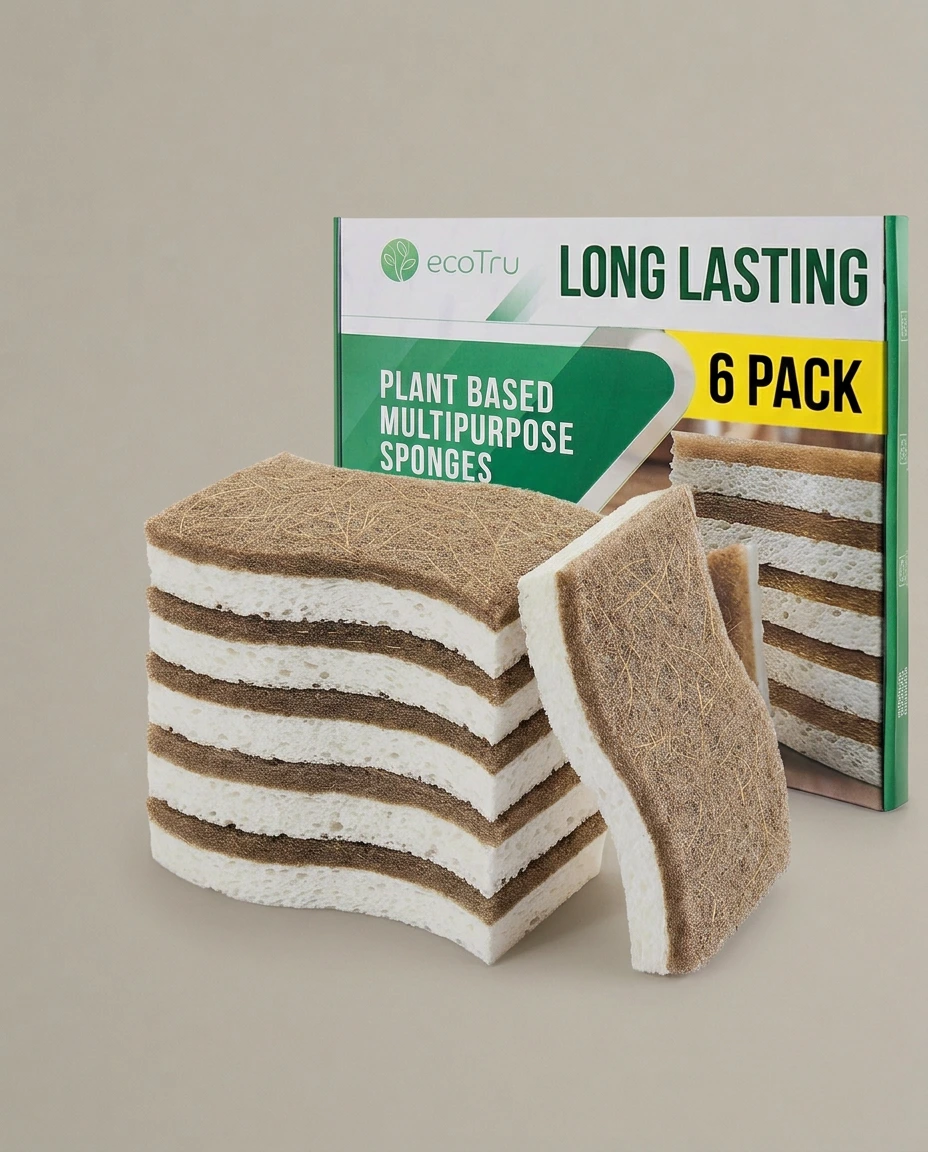
Product 2: Cellulose + Coconut Fibre Sponges
Two plant-based materials. Two sides. Zero plastic. Compost the whole thing when you’re done.
🥥 Cellulose + coconut husk — both renewable, both biodegradable
🧽 Dual-sided — soft cellulose for everyday washing, coconut fibre for stubborn grime
🚫 No synthetic foam, no petroleum, no microplastics
💨 Porous structure dries fast — which is why it doesn’t smell like your current sponge
📦 Plastic-free recyclable packaging — it’s not complicated but most brands still don’t bother
What It Actually Is
A dual-sided kitchen sponge made from two plant-derived materials. The white cellulose side is wood pulp, the same material as the Swedish dishcloth, compressed into a sponge format. It creates foam with dish soap, absorbs water and grease, and cleans surfaces without scratching. The tan coconut fibre side is the scrubber, derived from the outer husk of coconuts (the part that would otherwise be a waste product of coconut processing), it provides real abrasion for stubborn residue without scratching non-stick, glass, or ceramic surfaces.
The S-shape is an ergonomic detail worth noting. The curve makes the sponge easier to grip, reduces hand fatigue on bigger loads, and improves contact coverage inside bowls and pans. This is a minor but real design difference from a flat rectangular sponge.
Why This Format Specifically
The conventional kitchen sponge is polyurethane foam with a polyester or nylon scrubber bonded to it. The foam leaches no meaningful toxins into water at normal temperatures, but it does not biodegrade. It sheds synthetic particles. And it harbours bacteria in its synthetic pores in a way that open-cell natural sponges do not, because natural plant fibres dry faster and have less surface area for bacteria to persist on.
The cellulose + coconut sponge dries significantly faster than synthetic foam because the porous plant fibre structure allows airflow and evaporation rather than trapping moisture. This is why it smells better after a week of use. It is not magic; it is physics.
End of Life
When the sponge is spent, separate the two sides. Compost the cellulose half. The coconut fibre side decomposes more slowly. It can also go into compost, but should be cut into smaller pieces first. The packaging is recyclable cardboard.
One honest note: some users find the cellulose side slightly firmer and less flexible than conventional foam when brand new, because it is compressed during manufacturing. It softens quickly after the first few uses and with regular wetting. Start with lighter pressure on your first use.
What Real Customers Are Saying
“They clean just as well if not better than normal sponges. I like that it has a more abrasive side so you can get off tough stains.” — Verified buyer, Amazon
“Unlike its plastic counterpart, the porous structure helps it dry up quickly, lessening the chances for illness-causing compounds to breed.” — Verified buyer
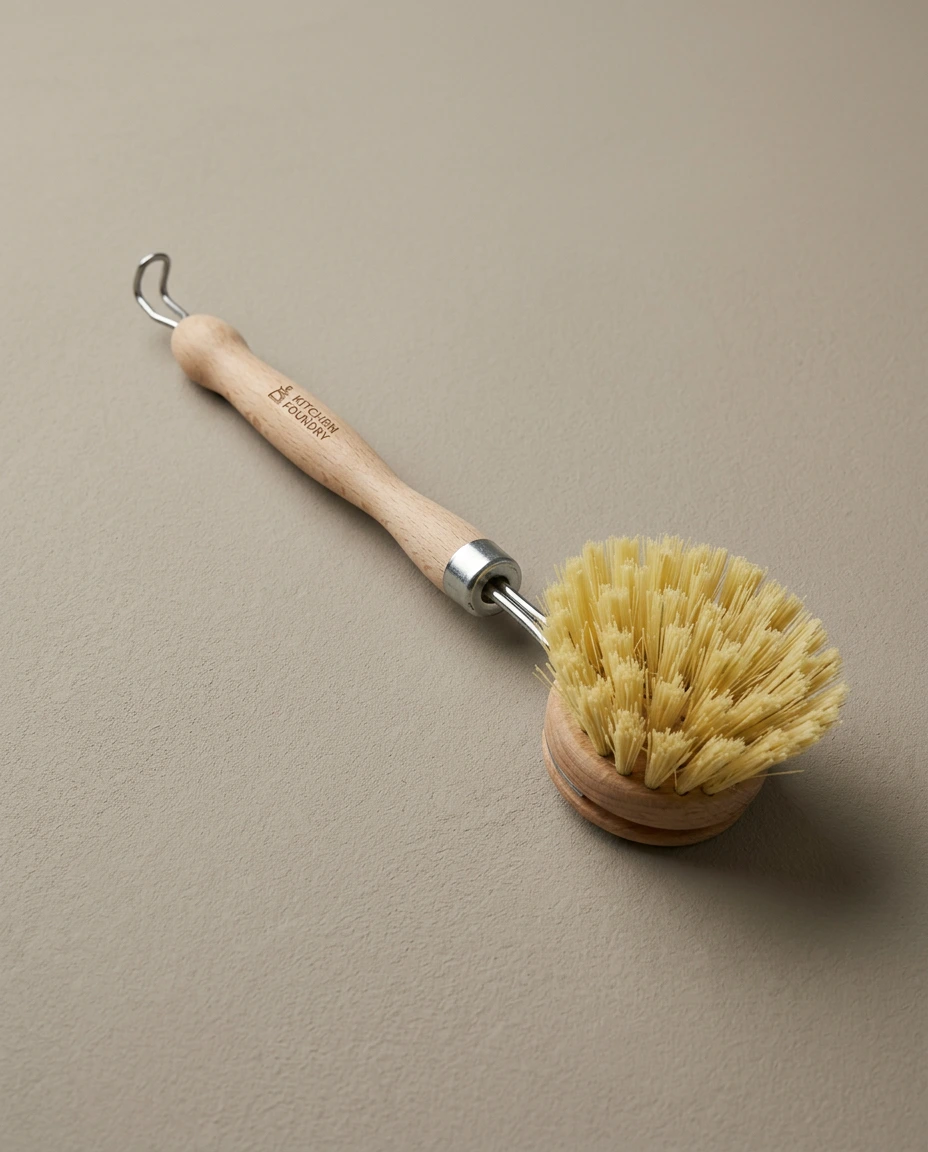
Product 3: Sorbo Wooden Dish Brush
From a conventional cleaning brand. The product itself is entirely biodegradable, has been made this way for decades, and costs less than most “eco” alternatives. More on the brand question below.
🪵 FSC-certified wood handle — responsibly sourced, fully biodegradable
🌵 Tampico plant fibre bristles — from the agave plant, stronger than most synthetic bristles in hot water
🔩 Metal hanging hook — not plastic, dries in the air between uses
💪 Ergonomic round head — gets into the bottom of pans and the inside of mugs
💶 ~€3 — priced the way a brush should be priced
What It Actually Is
An FSC-certified beechwood dish brush with a round head packed with tampico plant fibre bristles and a metal hanging hook. That is all it is. It has been made this way for decades.
Tampico is a fibre extracted from the leaves of Agave lechuguilla, a wild-growing agave plant harvested in Mexico. The fibre is naturally:
- Highly absorbent: it holds water and soap well, which is why it works in hot washing water without drying out quickly
- Heat-resistant: tampico withstands temperatures that would deform synthetic nylon bristles
- Stiff enough to scrub: the bristle density and natural roughness of agave fibre is effective on pans, pots, and baked-on food
- Fully biodegradable: when the brush is spent, handle, bristles, and all, it goes into compost or general organic waste
The round head is a practical advantage over flat brushes: it reaches the inside corners and bottom curves of mugs, bowls, and pans in a way that a flat pad doesn’t.
The metal hanging hook lets you store the brush vertically, which extends bristle life and keeps the brush hygienically dry between uses. Not storing your dish brush face-down on a wet surface is, in fact, the main reason a brush lasts longer than expected.
A Note on the Sorbo Brush
We typically feature products from brands that are built around sustainability as a core principle. Sorbo is not that brand. They’ve been making household cleaning tools in the Netherlands for over 50 years, and their product range includes microfibre cloths, synthetic sponges, and plastic-handled brushes. If you looked at their full catalogue and judged the brand as a whole, you would not call it an eco brand.
We’re featuring this specific product anyway, and we want to be direct about why.
The Sorbo wooden dish brush with tampico bristles is not a recent pivot to greenwashing. It is simply how Sorbo has made certain dish brushes for decades — FSC wood, plant-fibre bristles, metal hook — long before “sustainable product” became a marketing category. The product was never repositioned as eco-friendly. It just is, by material, fully biodegradable.
That is actually worth something. A lot of “eco” brands start with greener products from day one because there’s a market for them, which is fine, but a product that has existed in its current natural-material form before anyone was selling it as sustainable is, in a quiet way, more straightforwardly honest. The tampico bristles aren’t there because of a sustainability strategy. They’re there because they work better in hot water than nylon.
The brush also costs €3, which is what a dish brush should cost. Dedicated eco-focused brush brands often price similar products at €15–20. If you need the brand to match the product’s values across its full catalogue, those brands are a legitimate alternative. If what you need is a biodegradable brush that works, this one does.
We’re not endorsing Sorbo’s wooden brush. We’re recommending one product that happens to be made the right way, from a brand that doesn’t always make the right products. That distinction matters, and we’d rather say it clearly than either hide the brand’s broader range or refuse to feature a good product because the brand is imperfect.
The Sorbo wooden dish brush is sold in Albert Heijn, Jumbo, Gamma, and online for €2–3. It is widely available because it is not a niche eco product; it is a conventional Dutch household item. This is a feature, not a bug: you can buy it in a supermarket on the same trip as everything else.
What Real Customers Are Saying
“Gaat lange tijd mee. Het gebruik bij het reinigen van de afwas is goed.” [Goes a long time. Works well for washing up.] — Plein.nl verified buyer
“Goede hardheid haren. Prima product voor een goede prijs.” [Good bristle hardness. Great product for a good price.] — Plein.nl verified buyer
How They Work Together
These three products are designed to replace the three different cleaning tools most households use daily, each one covering a different function:
The Swedish dishcloth replaces the paper towel roll and the microfibre cloth — wiping, drying, light surface cleaning. Wash it when it needs it, hang it dry, use it for months.
The cellulose + coconut sponge replaces the synthetic kitchen sponge — washing up, scrubbing pots, cleaning surfaces with more abrasion. Compost it when it’s done.
The Sorbo wooden brush replaces the plastic dish brush — getting into cups, bottles, and the corners of pans. Keep it hung up and it will outlast most synthetic brushes significantly.
None of these are high-effort switches. They go in the same place. They do the same job. They cost comparable amounts. They don’t release microplastics down your drain. When they’re finished, they biodegrade.
How to Get the Most Out of All Three
Swedish dishcloth:
- Wet before first use and squeeze out — it will stiffen when dry, which is normal
- Colour-code by area: one cloth per room or task, so bathroom and kitchen never cross
- Hang vertically after use, not folded — it needs to dry fully between uses
- Wash at 60°C or higher once a week, or whenever it starts to smell
- For disinfection without a wash: dampen and microwave for 90 seconds
Cellulose + coconut sponge:
- The cellulose side is for everyday dishwashing and surface wiping
- The coconut fibre side is for scrubbing — pans, baked-on food, grout lines
- Rinse well after each use and hang or stand upright to dry
- Never leave sitting in standing water — it extends the life of the sponge significantly
- For non-stick cookware: the cellulose side is safe; the coconut side should be used with light pressure the first time you try it on a new surface
Sorbo dish brush:
- Hang it on the hook after use — this is the single biggest factor in how long it lasts
- Rinse bristles thoroughly after heavy use (baked cheese, egg, sticky residue)
- Boil briefly once a month to sanitise if you use it daily
- Replace when bristles splay or lose density — usually every 3–6 months depending on use
Our Verdict
The kitchen and bathroom cleaning tool category is one of the easiest in the household to upgrade, and the one most people overlook because the current products are so habitual.
The yellow-and-green sponge sitting next to your sink is not there because it is the best available option. It is there because it was cheap and convenient the day someone first put it there, and nobody questioned it since. It is also made of petroleum, releases microplastics every time you wash it, and smells within a week because its synthetic pores trap bacteria rather than drying out.
There is no version of this where switching to plant-based alternatives requires effort or sacrifice. The cloths, sponges, and brush on this page do the same jobs for comparable prices. The only difference is what happens to them when they’re finished — whether they go into landfill as permanent plastic waste, or into a compost bin as organic matter.
Get all three if you want a complete swap. They cover every cleaning job in a kitchen sink context.
Get just the sponges and brush if you’re starting small — these are the most direct replacements for what most households currently use most often.
Get just the Swedish dishcloth if paper towels are your main habit to break — one cloth per household handles more daily cleaning than most people expect before they try it.
Ready to Make the Switch?
- Shop Wild & Stone Swedish Dishcloths →
- Shop Cellulose + Coconut Sponges →
- Shop Sorbo Wooden Dish Brush →
Green Goods Gallery earns a small commission if you purchase through these links, at no extra cost to you. We only feature products we genuinely believe in — and in this case, we’ve told you exactly why we feature one of them despite its brand context.