

Eco-Friendly Laundry Bag: Capture Microplastics With Each Wash
Every time you do laundry, you’re releasing thousands of plastic fibres into the water system. This bag catches most of them.
The Guppyfriend Washing Bag. Patented. Third-party tested. The most effective tool available for reducing microplastic release from your washing machine.
🧺 86% fewer synthetic fibres break during washing — independently verified by the Fraunhofer Institute UMSICHT
🔬 50-micron mesh — tight enough to trap microfibers while allowing water and detergent to circulate freely
🪡 The bag itself does not shed — made from monofilaments described as “more like stable sticks than threads”; the structure stays intact through repeated washing
🧪 Third-party tested by the Fraunhofer Institute UMSICHT, the German Textile Research Centre North-West (DTNW), and the University of California Santa Barbara as part of the Patagonia research program
🏆 German Sustainability Award winner — displayed permanently in the Victoria and Albert Museum collection in London
♻️ Recyclable — remove the metal zipper, and the polyamide bag can be recycled as a single material
🌍 Created by Stop! Micro Waste — the NGO founded by Alexander Nolte and Oliver Spies, built on the specific goal of addressing microplastic pollution at source
Size: 50×74cm, holds a standard laundry load of synthetic clothing
Material: 100% untreated, undyed polyamide monofilament
Fill to: two-thirds capacity maximum
The Microplastic Problem That The Laundry Bag Is Solving
Synthetic textiles (polyester, nylon, acrylic, elastane, fleece) shed tiny plastic fibres every time they’re washed. These fibres are too fine for most wastewater treatment plants to capture effectively. They pass through, enter rivers and oceans, and accumulate in aquatic ecosystems and marine organisms. From there, they enter the food chain.
Research estimates that a single wash of a synthetic fleece jacket can release more than 1,900 microfibres. A standard load of laundry releases considerably more. Across millions of households washing synthetic clothing daily, the cumulative volume entering waterways is enormous. Synthetic microfibers account for approximately 35% of the microplastics found in the ocean, the single largest identified source.
The conventional advice is to wash less, wash on cold, and use a shorter cycle. That reduces shedding at the margins. The Guppyfriend bag reduces it by 86% and physically captures the fibres that do break, so they go into the bin rather than the drain.
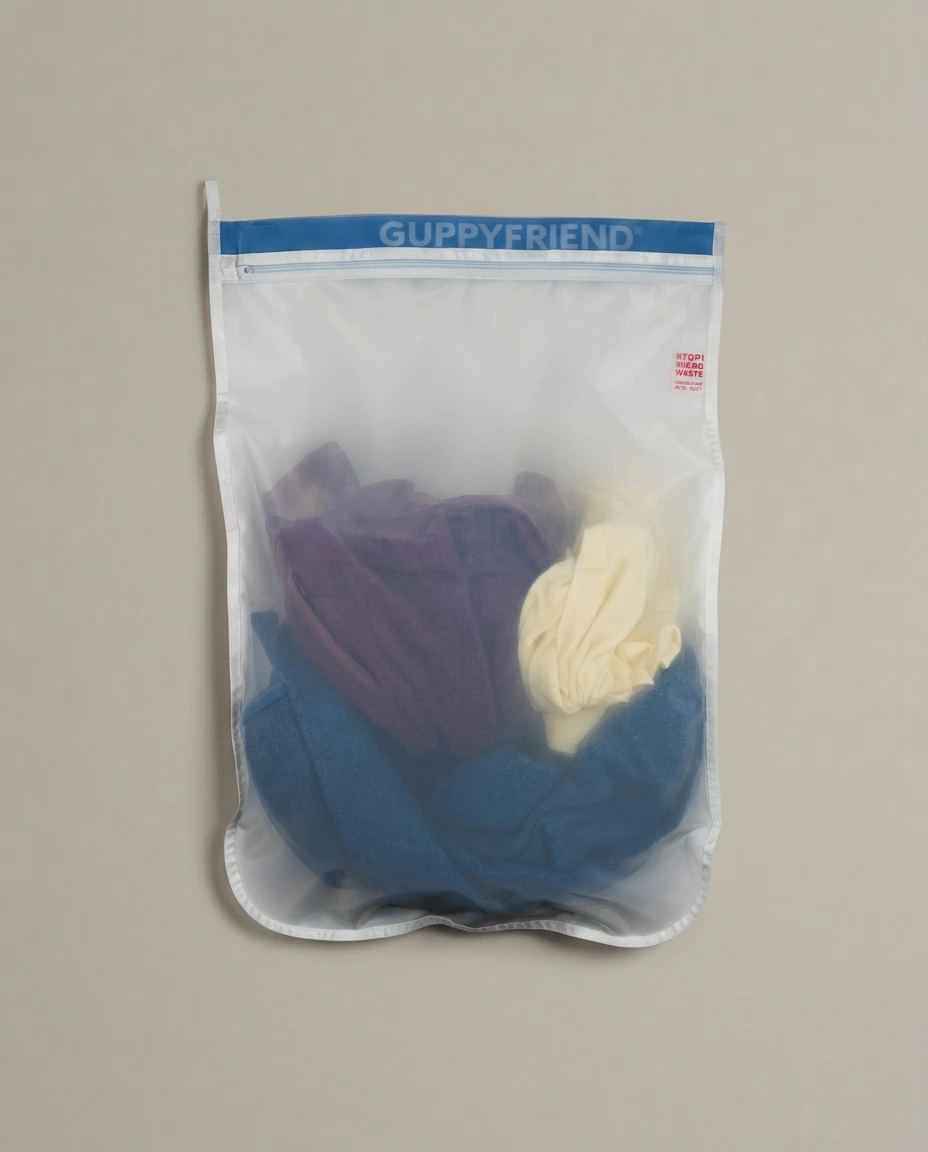
The Guppyfriend Washing Bag
The GUPPYFRIEND Washing Bag is a patented, high-tech laundry bag that tackles the microfiber problem at the source: load your synthetic garments inside, zip it shut, and wash as normal. The bag’s monofilament filter material captures the shed fibres without releasing any microplastics of its own. After the wash, you collect the trapped fibres from the seam and bin them. It also reduces pilling, which means your clothes last longer. Made in the EU, tested, and about as low-effort as sustainable swaps get.
How It Works
The bag is woven from a single continuous thread of untreated, undyed polyamide monofilament into a 50-micron mesh. The structure is tight enough that broken microfibers cannot pass through the weave and into the wash water, but open enough that water and detergent move freely through it, cleaning the clothes inside normally.
The monofilament construction is the key design decision. Most synthetic fabrics are made from twisted or woven multifilament threads, which abrade against each other and shed fibres as they do. Monofilaments are single, smooth strands. Under the mechanical stress of a washing cycle, they stay intact. This is why the bag itself does not contribute to the microplastic problem it’s designed to solve.
Broken fibres from the clothing inside collect in the corners and along the seams of the bag’s zip closure after each wash. You peel them off and bin them. They go to landfill, not the drain. This is not a perfect outcome, but it is substantially better than releasing them into waterways where they cannot be recovered.
The Honest Notes
It reduces shedding by 86%, not 100%. Some fibres will still pass through during washing. The bag is, as Guppyfriend’s own website states, “only a first step towards a holistic solution to microfiber pollution.” It is the most effective first step currently available as a consumer product, but it does not eliminate the problem.
It does not capture nanoplastics, dissolved chemical substances, or dust particles from production. The 50-micron mesh filters fibre-scale particles. Dissolved substances pass straight through. A complete solution to laundry-derived water pollution does not yet exist in a single product.
The fibres you collect still go to landfill. There is no consumer pathway for recycling or safely disposing of captured microfibers. Binning them is the correct choice over rinsing them down the drain, but it is worth understanding that “capturing” them does not make them disappear.
The bag is synthetic. Polyamide is a plastic. This feels counterintuitive for a product designed to reduce plastic pollution. The reason it works is the monofilament construction, which does not shed. A cotton bag would biodegrade eventually, but would also harbour bacteria and potentially break down faster under repeated hot washing. The design choice is intentional and justified, but it is worth knowing.
It works best with synthetic clothing. Natural fibres like cotton and wool also shed during washing, but those fibres biodegrade in waterways without the same environmental persistence. You can put natural fibre clothing in the bag too, but the environmental priority is synthetic fabrics such as polyester, nylon, acrylic, fleece, and blends.
How to Use It
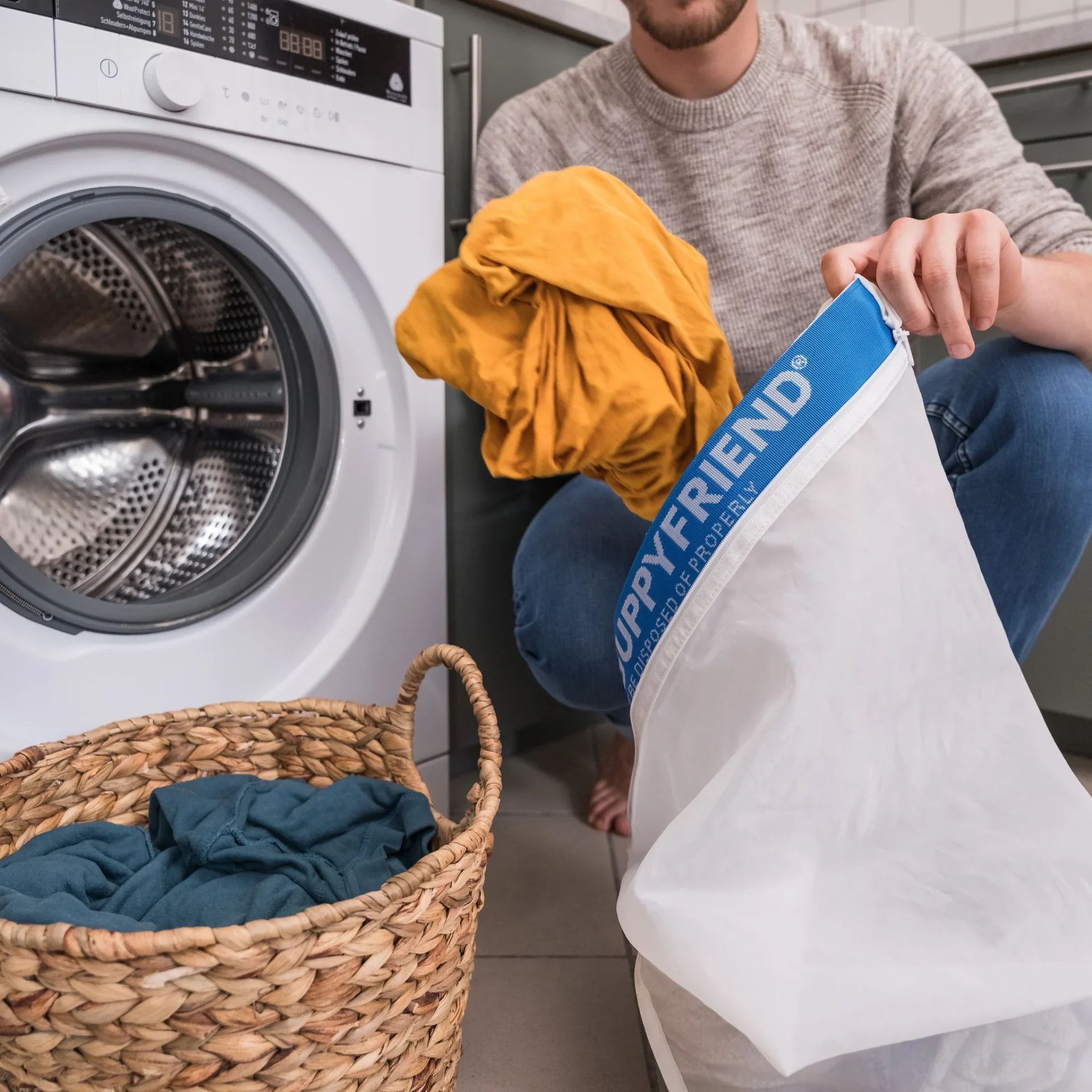
Fill the bag to two-thirds capacity. Not more. The clothes need room to move freely for the bag’s protective effect to work. An overpacked bag reduces air and water circulation, which reduces both cleaning effectiveness and fibre retention in the corners.
Wash as normal. Any temperature, any programme, any detergent (or an eco-friendly detergent). The bag does not require any change to your usual routine except filling it before loading and removing it when the cycle ends.
After the wash: unzip the bag and remove your clothes. Look at the corners and the zip area. You will find a small cluster of fibres. Peel them off and put them in the bin, not down the sink. After a few washes, this becomes a two-second habit. But some users report no microfiber accumulation even after 5-6 washing cycles.
The bag is self-cleaning. You do not need to wash it separately. It comes clean in the same cycle as the clothes inside it.
Over time: the bag will show wear from repeated use. Guppyfriend recommends replacing it when you notice the mesh structure beginning to degrade. The polyamide material can be recycled as a single material when the metal zipper is removed; check your local recycling options for nylon textiles.
GUPPYFRIEND Washing Bag Reviews
“I use it for all my synthetic workout gear. The amount of fibres that collect in the corners is genuinely alarming once you see it — which, perversely, is exactly why I keep using the bag.” — Verified buyer
“Simple idea, works as described. Takes about five seconds to peel the fibres out after each wash. I can’t imagine not using it now.” — Verified buyer
“Clothes come out just as clean. The bag holds a full gym kit without any issue. I’d recommend buying two if you do a lot of synthetic laundry.” — Verified buyer
The last point is practical and worth emphasising: if your household washes a lot of synthetic clothing, one bag fills up quickly. Two bags running in rotation is the more comfortable setup for most households.
Our Verdict
The Guppyfriend bag is not a complete solution to microplastic pollution from laundry. Guppyfriend themselves say this explicitly, which is the kind of honesty that belongs in the verdict of a product page rather than hidden in their FAQ.
What it is: the most effective and best-evidenced consumer tool currently available for reducing microplastic release from washing synthetic clothing. 86% fewer broken fibres, independently tested, patented design, verified by Fraunhofer, and physically capturing what does break so it goes to a bin rather than a river.
For a household with synthetic sportswear, fleece layers, polyester basics, or any of the fast-fashion synthetics that dominate most wardrobes, this is one of the more impactful purchases on this entire site. Most of the products here replace something. This one addresses a form of harm that happens quietly, invisibly, behind the closed door of a washing machine, every time you do laundry.
Buy it. Use it for every synthetic wash. The collected fibres will make the case for itself the first time you see them.
Also relevant from Green Goods Gallery:
The Mother’s Earth Laundry Sheets work well inside the bag. The sheets dissolve through the mesh normally, and the combination means your synthetic wash is both detergent-cleaner and microfiber-contained in the same cycle.
Check out our Eco-Friendly Laundry Sheet page →
Shop the Guppyfriend Washing Bag
Patented. Third-party tested. The most effective tool available for reducing microplastic release from your washing machine.
Buy the Guppyfriend Washing Bag →
Green Goods Gallery earns a small commission if you purchase through this link, at no extra cost to you. We only feature products we genuinely believe in.