


Eco-Friendly Hair Care Products: Natural Shampoos & Bars
Your shampoo bottle will outlive everyone in this room, and you bought another one last month. Three eco-friendly hair care products, some better than others, but all better than the most traditional options.
Why Eco-Friendly Hair Care Matters More Than You Think
The global hair care industry produces an estimated 552 million shampoo bottles every year, most of which end up in landfills. Plastic shampoo bottles are technically recyclable but rarely recycled in practice, partly because residual product contaminates the recycling stream, and partly because HDPE bottles from different brands often can’t be processed together at scale. The result is a category with a very high purchase frequency, very low end-of-life accountability, and a lot of very confident greenwashing.
The most effective solution to a shampoo bottle is not a bottle at all.
A solid natural shampoo bar generates less CO₂ equivalent than its liquid counterparts when measured across production, transport, and disposal. This is partly because liquid shampoo is 70–80% water; you are paying to ship water, in plastic, across supply chains, and partly because bars are more concentrated, so they last longer per gram of product.
The products below are ranked by how far they take you from that plastic bottle. The best option eliminates it. The alternatives exist for people who aren’t ready for the full switch yet.
The Science Behind Rosemary in Hair Care
All hair care products on this page use rosemary as a primary active ingredient. That is not a coincidence, and it is not just a scent choice. Here is what the research actually shows — no overstating, no wishful thinking.
The key 2015 study: A randomised comparative trial by Panahi et al. (published in SKINmed) compared topical rosemary oil to 2% minoxidil in 100 patients with androgenetic alopecia over six months. Both groups showed a significant increase in hair count at the six-month mark. No significant difference was found between the groups regarding hair count, and scalp itching was significantly more frequent in the minoxidil group than in the rosemary group.
What this means and doesn’t mean: Rosemary essential oil, applied topically twice daily for six months, matched the performance of minoxidil 2% in this specific population (genetic pattern hair loss in men). The comparison was to minoxidil 2%, not the more commonly used 5% concentration. The study used pure essential oil applied directly to the scalp — results from rosemary shampoo or extract may differ. The trial had no untreated control group. This is a real result from a well-designed study. There is no proof that rosemary shampoo reverses balding.
Why it works mechanically: Rosemary oil improves microcirculation in the scalp, increasing blood flow to follicles and delivering oxygen and nutrients where they are needed. It also appears to prolong the anagen (active growth) phase of the hair cycle, keeping hair in active growth for longer.
The honest summary: Rosemary is genuinely one of the better-evidenced natural hair care ingredients. A shampoo cannot deliver the same scalp-contact concentration as a topical treatment oil, so the evidence does not transfer directly. What it does mean is that the ingredient is doing real work in these formulas, not just occupying the label.
Option 1: Arista Rosemary & Biotin Shampoo Bar
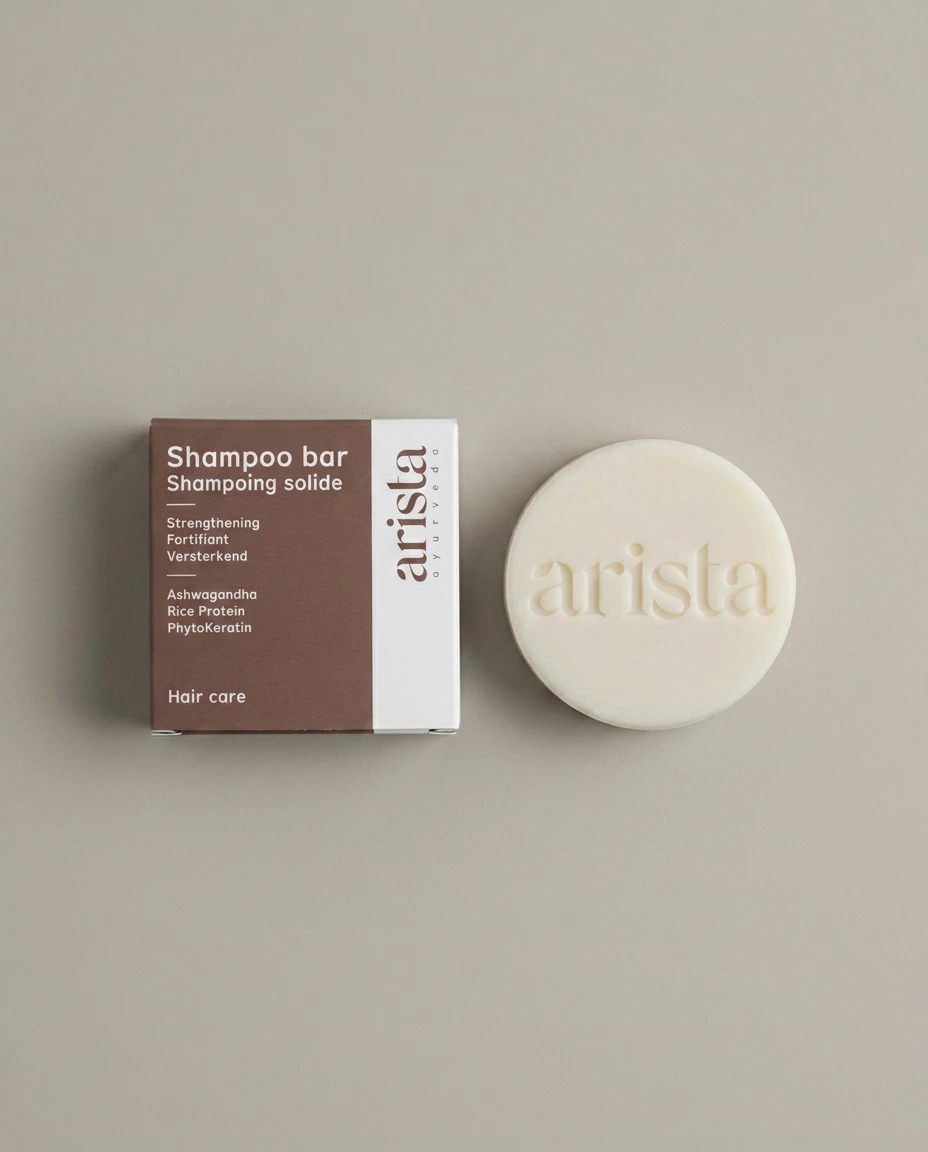
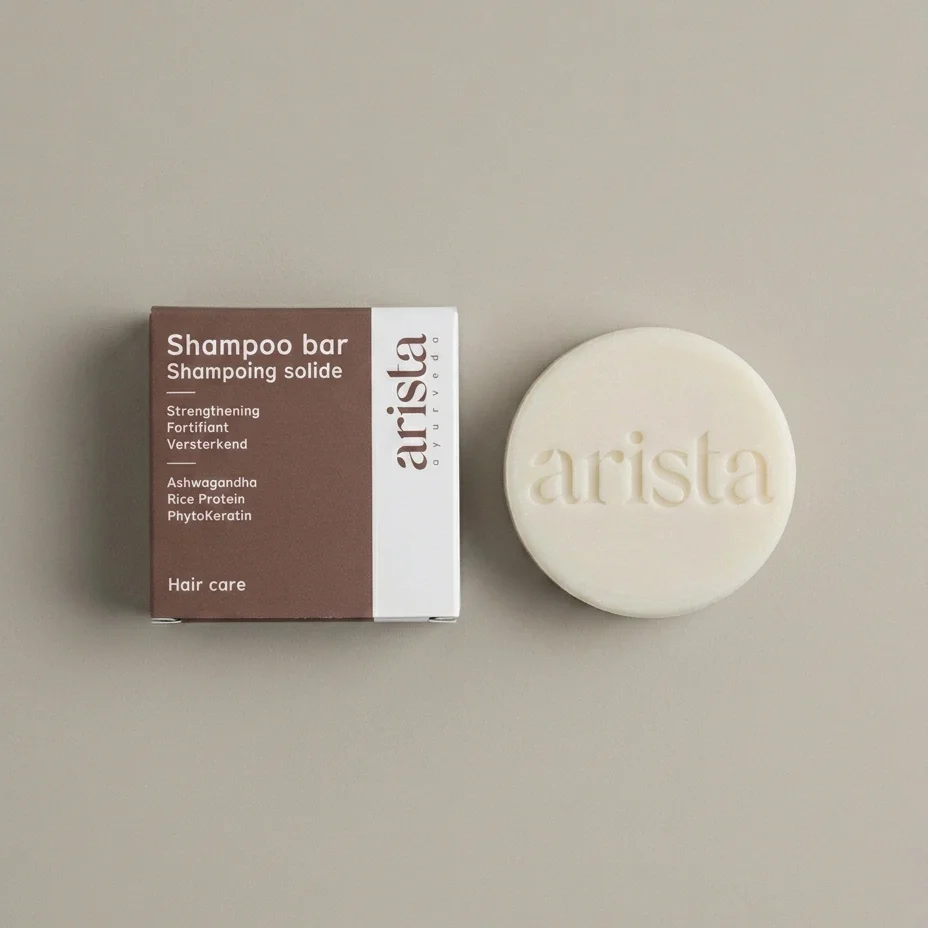
Zero plastic. Concentrated formula. Ayurvedic ingredient philosophy. The most sustainable hair care.
🧼 Solid bar format — zero plastic packaging, no bottle, no single-use waste
💧 Uses significantly less water to produce — liquid shampoo is 70–80% water; bars are concentrated from the start
🌿 Rosemary + Biotin + Caffeine — three actives with complementary mechanisms for scalp health
🚫 Sulfate-free, silicone-free, paraben-free — no SLS, no film-forming polymers
🌱 Vegan, cruelty-free
✈️ TSA-compliant — not a liquid, no 100ml restrictions, no leaking in a bag
📦 Plastic-free packaging — recyclable cardboard
🏺 Ayurvedic formulation philosophy — botanical-first, developed around traditional scalp care principles
What It Actually Is
A natural shampoo bar built around three active ingredients, rosemary essential oil (Rosmarinus Officinalis Leaf Oil), biotin, and caffeine, in a concentrated base of Sodium Cocoyl Isethionate (SCI), a surfactant derived from coconut oil that is significantly milder than SLS and commonly used in baby care products.
The base formula is straightforward: SCI does the cleansing, hydrogenated vegetable oil provides the binding structure, glycerin moisturises, Polyglyceryl-4 Laurate (a plant-derived emulsifier) stabilises the formula, and tetrasodium glutamate diacetate is the same biodegradable chelating agent found in the Marcel’s Green Soap all-purpose cleaner; it manages hard water mineral interference so the actives can do their job.
The Arista brand draws on Ayurvedic ingredient philosophy, the practice of combining botanical actives with long traditional use records, formulated around scalp renewal rather than just surface cleaning. This is reflected in the ingredient choices: rosemary for circulation, biotin for strand structure, and caffeine for follicle stimulation.
The Active Ingredients, Explained
Rosemary Essential Oil (Rosmarinus Officinalis Leaf Oil) improves scalp microcirculation, delivers antioxidant protection to follicles, and has antimicrobial and anti-inflammatory properties. The 2015 Panahi trial, discussed above, provides the most relevant clinical context for its efficacy. In a shampoo, the contact time is shorter than in a leave-on treatment, so direct growth effects should not be overstated, but the scalp environment benefit is real.
Biotin (Vitamin B7), a water-soluble B vitamin involved in keratin synthesis, the protein that makes up the hair shaft. Topical biotin’s efficacy is less established than oral supplementation, but it is present in the formula as a supportive ingredient. Biotin deficiency causes hair thinning and brittleness; for those with adequate dietary intake, topical application is primarily a structural support ingredient rather than a growth driver.
Caffeine — when you apply caffeine directly to your scalp, it sinks into your hair follicles and essentially removes a biological “brake” that was slowing down hair growth. A 2014 study has shown that it actually makes individual hair strands grow longer and encourages the cells responsible for hair production to multiply. It’s also particularly useful for people with genetic hair loss, because it fights back against the hormone (testosterone) that shrinks and weakens follicles over time. The tingling you might feel when you use it isn’t irritation — it’s your blood vessels widening and circulation improving, which is exactly what you want.
Who It Works For
Fine, flat, or thinning hair that needs volume and scalp activation. Normal to oily hair types that respond well to lightweight cleansing. Anyone transitioning from conventional shampoo who wants a plastic-free option without compromising scalp health.
The Honest Notes on Switching to a Shampoo Bar
The most common reason people abandon shampoo bars is a 2–3 week transition period during which hair may feel waxy or different. This happens for one of two reasons:
- Hard water interaction: Soap-based bars (not SCI-based bars like Arista) react with calcium and magnesium ions in hard water to form insoluble residue. Arista uses SCI, not soap, which largely avoids this issue — but if you live in a very hard-water area (most of the Netherlands), a diluted apple cider vinegar rinse after washing for the first two weeks removes any mineral build-up and speeds the transition.
- Silicone detox: Conventional shampoos coat the hair shaft with silicones that create smoothness by sealing the cuticle. When you stop using silicone-based shampoo, hair temporarily feels different until the coating breaks down. This is not damage — it is your hair returning to its natural texture without the synthetic coating. It passes.
How to use: Wet hair thoroughly. Rub the bar between your palms to create a lather, then apply the lather to your hair and scalp. Alternatively, rub the bar directly onto the scalp. Massage in, rinse thoroughly. Store the bar on a soap dish or in a ventilated tin between uses. Do not let it sit in water, which dissolves it faster.
Storage Tin For Travel
A shampoo bar storage tin by Arista is also available to carry your shampoo bar wherever you go. It is a compact, round tin made from 100% aluminium: rust-proof, shatterproof, and completely plastic-free. It comes with a removable draining grid that lifts the bar off the base, allowing water to drain away and air to circulate so your shampoo bar stays firm instead of turning into a soggy mess. The leakproof design makes it genuinely travel-friendly, whether it’s going in a gym bag or a suitcase. Designed to fit Bambaw’s own Arista shampoo bars, it also works with any soap of equal or smaller size. Rinse it clean in seconds.
Reviews
“This shampoo bar is amazing! My hair feels clean, lightweight, and full of volume after every wash. It lathers really well and a little goes a long way.” — Verified buyer, Amazon
“My hair feels so much lighter and has more volume than it ever did with liquid shampoo. Took about two weeks to fully adjust but now I wouldn’t go back.” — Verified buyer
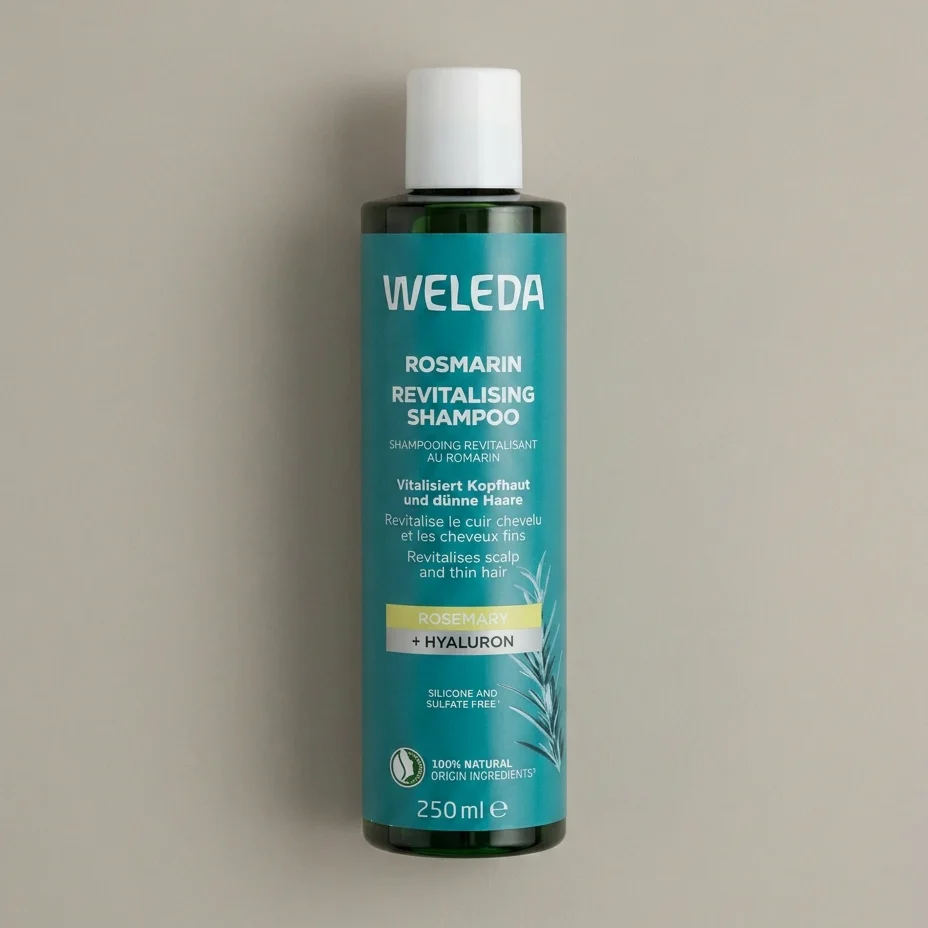
Option 2: Weleda Rosemary Revitalising Shampoo
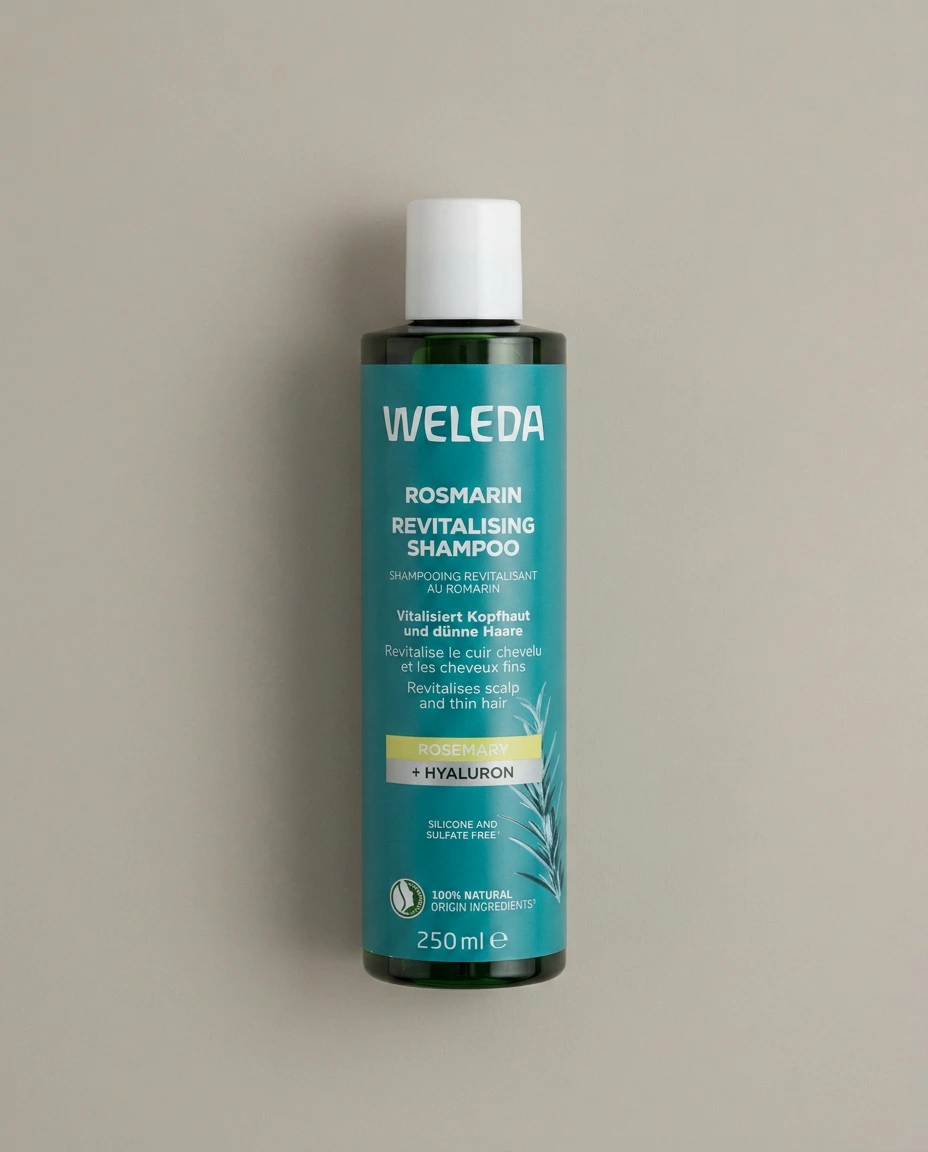
Natural formula, trusted brand, plastic bottle: the honest trade-off explained.
🌿 100% natural origin ingredients — NaTrue certified natural cosmetics
🧴 Liquid format — familiar application, richer lather than a bar
💧 Hyaluronic acid (Sodium Hyaluronate) + organic rosemary oil — scalp hydration plus circulation support
🚫 No silicones, sulfates, synthetic fragrance, or petroleum-derived ingredients
🌱 Vegan, cruelty-free — certified by Weleda’s own NaTrue-aligned standards
⚠️ Plastic bottle — the honest downside of this option
Size: 250ml | Origin: Germany / Switzerland
What It Actually Is
Weleda has been making certified natural personal care products since 1921. Their Rosemary Revitalising Shampoo is part of a newer rosemary range designed to address scalp health and hair volume, built on the same principles as their century-old Revitalising Hair Tonic, which has remained a bestseller for over a hundred years and recently became a viral TikTok recommendation.
The formula is 100% natural origin ingredients, NaTrue certified, sulfate-free, and silicone-free. The surfactant system uses Coco Glucoside and Disodium Cocoyl Glutamate, both plant-derived, both considerably gentler and more biodegradable than conventional SLS systems. Betaine, derived from sugar beet, contributes to secondary cleansing and foam conditioning. The hyaluronic acid (Sodium Hyaluronate) retains moisture at the scalp surface, addressing dryness that can contribute to reduced hair density and brittleness.
Full ingredient list: Aqua, Alcohol Denat, Coco Glucoside, Glycerin, Disodium Cocoyl Glutamate, Xanthan Gum, Betaine, Rosmarinus Officinalis (Rosemary) Leaf Oil (organic), Tocopherol (Vitamin E), Citric Acid, Lecithin, Sodium Hyaluronate, Ascorbyl Palmitate (Vitamin C ester), Glyceryl Oleate, Sodium PCA, Sodium Cocoyl Glutamate, Hydrogenated Palm Glycerides Citrate, Parfum, Beta-Caryophyllene, Camphor, Limonene, Pinene.
The Plastic Bottle Caveat
This is a liquid shampoo in a plastic bottle. The formula is exemplary from an ingredient standpoint. The packaging is not. Weleda runs a recycling programme where empty bottles can be returned — not yet widely available in the Netherlands — but under normal disposal, this bottle faces the same end-of-life reality as any HDPE plastic: probable landfill.
We feature this product because the formula is genuinely clean, the brand is credible, and for people who find shampoo bars challenging (very long or textured hair, hard water adaptation issues, or a strong preference for liquid format), this is the most responsible liquid option available in this category. We do not feature it as an equivalent sustainable choice to the Arista bar. It is the better liquid option — not the better overall option.
Who It Works For
Anyone who wants a proven, clean-formula liquid shampoo with real rosemary activity. Fine hair that needs volume without silicone coating. Scalp-sensitive users. People who want to reduce harmful ingredients without changing the format entirely.
Reviews
“Lovely shampoo, my hair has more volume and shine than with my previous shampoo.” — Verified buyer, Amazon
“It has a natural herby, refreshing scent. I have fine hair which doesn’t like anything heavy and this is perfect — I’m not left with any greasy or flat feeling.” — Verified buyer, Amazon UK
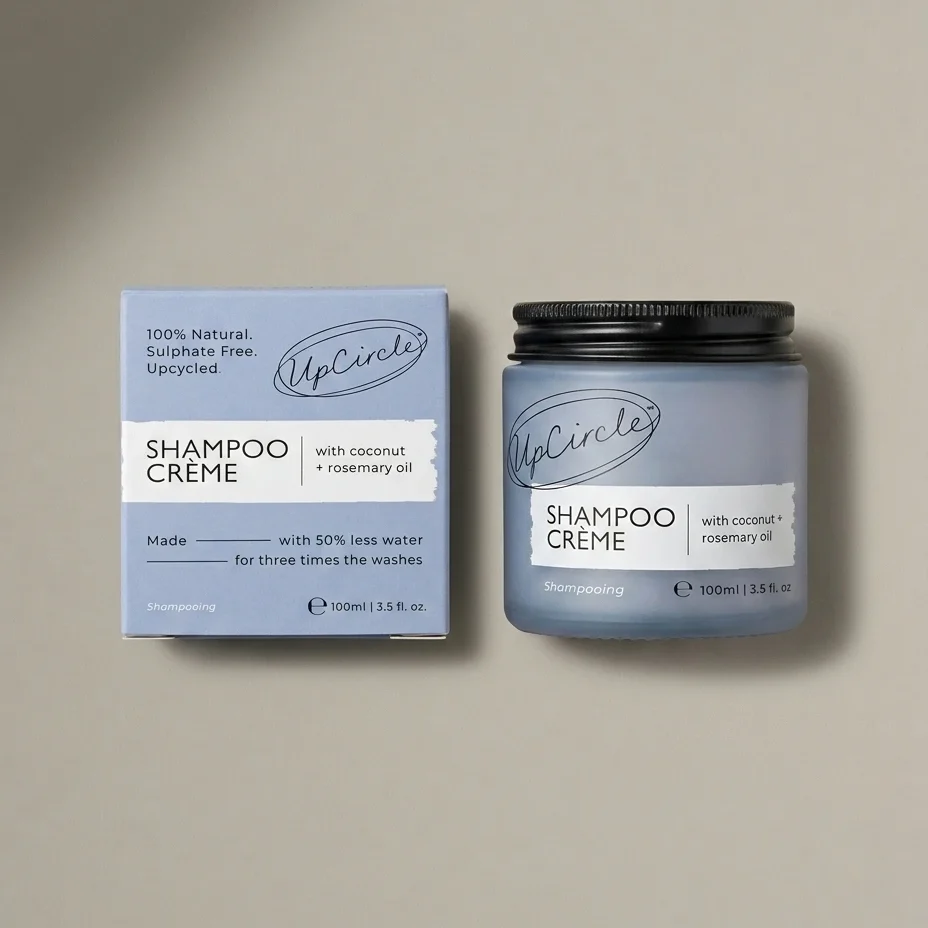
Option 3: UpCircle Shampoo Crème with Rosemary + Upcycled Pink Berry
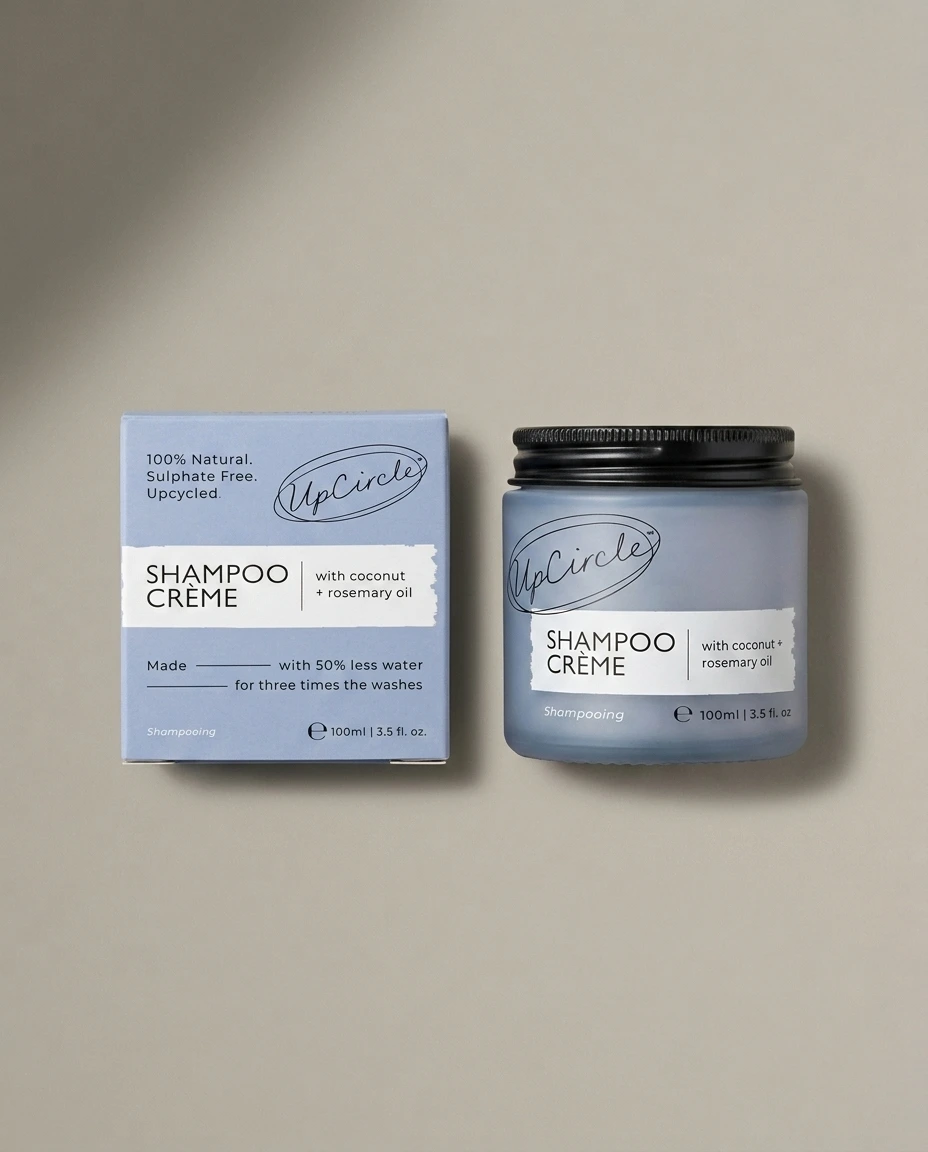
Premium. Glass jar. Upcycled ingredients. Concentrated enough to replace three bottles. B Corp certified.
🫙 Glass jar with recyclable aluminium lid — no plastic, refillable vessel
♻️ Made with upcycled pink berry extract — a by-product of the fragrance industry, diverted from waste
💧 50% less water than standard liquid shampoo — concentrated formula, fewer transport emissions per wash
🔁 Delivers approximately 3× the washes of a liquid shampoo bottle — economic and environmental efficiency
🌿 Rosemary oil + coconut oil + peppermint + grapefruit peel oil — multi-active formula
🚫 No SLS, SLEs, parabens, silicones, mineral oil, or parfum
🏆 Winner, Top Santé Haircare Awards 2023 — Best Shampoo for Textured/Afro Hair
🌍 B Corp certified, Plastic Negative — independently verified sustainability commitments
Format: cream/paste hybrid — not solid, not liquid, something between the two
What It Actually Is
UpCircle was founded on a question: what if every ingredient in a product had already served a purpose somewhere else? Their entire range is built around upcycled materials: coffee grounds, chai spices, fruit peels, flower stems, and in this case, pink berries (Schinus Terebinthifolia) sourced as a by-product from the fragrance industry’s distillation process.
Pink berry extract (Schinus Terebinthifolia Seed Extract) is clinically proven to reduce scalp redness and irritation, and to reduce flaking. In the fragrance industry, the aromatic compounds are extracted, and the seed residue is discarded. UpCircle uses that residue as an active scalp-soothing ingredient instead. This is not greenwashing. It is a genuinely different approach to formulation: using something that already exists as waste, rather than growing or extracting something new.
The shampoo crème format is a high-concentration paste, not a solid bar, not a liquid. A blueberry-sized amount per wash is the standard dose for short to medium hair. Because the formula contains 50% less water than a standard liquid shampoo, the same weight of product delivers roughly three times the washes. The glass jar is 100ml or 200ml. This is where the premium pricing makes sense: the per-wash cost is lower than it appears.
Full ingredient list: Sodium Methyl Cocoyl Taurate, Sodium Cocoyl Isethionate, Aqua, Glycerin, Cocos Nucifera (Coconut) Fruit Oil, Rosmarinus Officinalis (Rosemary) Leaf Oil, Schinus Terebinthifolia Seed Extract (upcycled pink berry), Mentha Piperita (Peppermint) Leaf Oil, Citrus Grandis (Grapefruit) Peel Oil, Lavandula Angustifolia (Lavender) Flower Oil, Cedrus Atlantica (Cedarwood) Bark Oil, Eugenia Caryophyllus (Clove) Flower Oil, Glyceryl Caprylate, Sodium Levulinate, Sodium Anisate, Maltodextrin, Limonene*, Linalool*. (Natural constituent of essential oils.)
The Packaging Position: Between Bar and Bottle
The glass jar is infinitely recyclable and reusable. But UpCircle themselves are direct about why they didn’t make a solid bar: shampoo bars without palm oil derivatives are not suitable for afro and textured hair types. The crème format lathers more fully than a bar and works for all hair types, including colour-treated, textured, and afro hair, without the adaptation issues or hard water sensitivity of solid bars.
Who It Works For
All hair types, including textured and afro hair. Anyone willing to pay a premium for the most circular available format after a solid bar. Colour-treated hair (sulfate-free formula preserves dye). Scalp-reactive hair (pink berry is clinically validated for irritation reduction). People who want liquid convenience without a plastic bottle.
Reviews
“This has completely transformed my hair post-partum, now it’s softer and healthier than it’s ever been!” — Verified buyer
“I was skeptical because of my long coloured hair, but actually… what a difference these two have made!!” — Verified buyer
“Once used will likely mean you never go back to liquid shampoo.” — Independent reviewer
How They Compare
| Arista Shampoo Bar | Weleda Shampoo | UpCircle Shampoo Crème | |
| Packaging | Zero plastic ✅ | Plastic bottle ⚠️ | Glass jar ✅ |
| Format | Solid bar | Liquid | Cream/paste concentrate |
| Per-wash cost | Low (long-lasting) | Standard | Low ( 3x concentrated) |
| Hard water sensitivity | Low (SCI-based) | None | None |
| Transition period needed | 2–3 weeks possible | None | None |
| Rosemary active | ✅ | ✅ | ✅ |
| Upcycled ingredients | ❌ | ❌ | ✅ |
| Certification | Vegan, cruelty-free | NaTrue | B Corp, Plastic Negative |
| Best for | Fine/oily/normal hair | Fine/sensitive, liquid preference | All hair types incl. textured |
| Suitable for colour-treated | ✅ | ✅ | ✅ |
Our Verdict
The hair care category has an enormous, entirely unnecessary plastic problem. The Arista shampoo bar eliminates it. Not partially, entirely. For the majority of hair types and washing routines, a solid SCI-based bar with active botanical ingredients performs as well as liquid shampoo, generates no plastic, and costs less per wash over time.
The transition period is real and worth acknowledging honestly: two to three weeks of adjustment is common, especially in hard water areas. The apple cider vinegar rinse method shortens it significantly. Once through it, most people do not return to liquid shampoo.
For people who need liquid format: textured or afro hair, persistent hard water problems, or genuine preference, the UpCircle crème is the most credible alternative. It is concentrated enough to reduce the per-wash footprint dramatically, with glass packaging, an upcycled ingredient philosophy, and independently verified sustainability.
The Weleda shampoo is the honest choice if you want a clean-formula liquid and are prepared to accept the plastic bottle trade-off without pretending it doesn’t exist. It is also easy to find offline, not just through us. You’ll spot it at Kruidvat and Holland & Barrett, among other retailers, so if you prefer to grab it in person or check the packaging before buying, that’s an option too.
The rosemary ingredient is real across all three. The science supports scalp circulation benefits and some evidence for follicle health. A shampoo is not a clinical treatment. These products support a healthy scalp environment, which is where good hair growth starts, rather than reversing established hair loss. Keep that distinction clear, and you will not be disappointed.
Shop Eco-Friendly Hair Care Products
- Arista Rosemary & Biotin Shampoo Bar — Most Sustainable →
- Arista Anti-Dandruff Travel Bar + Tin →
- Weleda Rosemary Revitalising Shampoo — Best Liquid Option →
- UpCircle Shampoo Crème — Premium Circular Option →
Green Goods Gallery earns a small commission if you purchase through these links, at no extra cost to you. We only feature products we genuinely believe in.