


Face Cleanser and Exfoliator for Sensitive Skin, No Plastic
A face cleanser is the product you use most and think about least. You use it twice a day, it goes straight down the drain, and it usually comes in a plastic bottle that is mostly water. Add exfoliation and it gets harder: coarse scrubs can scratch, acids can sting sensitive skin, and plastic microbeads were banned in the EU for good reason.
So we looked past the label. We checked the full ingredient list, the packaging, the brand behind it and the certifications we could confirm with the certifiers themselves, and we tried it ourselves for four weeks. For now there is one product on this page: Bioli’s Clarifying Cleanser and Exfoliator, a 2-in-1 that uses enzymes instead of acids or grains. It is a strong pick for sensitive skin, with a few honest caveats. We’ll add more cleansers when we find ones that hold up.
Scrub, Acid or Enzyme: Which Exfoliation Is Gentlest?
There are three ways to remove dead skin cells, and they work very differently.
Scrubs rub dead skin off with grains. Fine grains can be gentle, but coarse ones like crushed nut shells or fruit pits can leave tiny tears in the skin. Plastic beads are no longer an option: the EU banned them in rinse-off products in October 2023.
Acids (AHAs like glycolic acid, BHAs like salicylic acid) loosen the bonds between dead cells. They work fast, but they can irritate sensitive skin and make it more sensitive to the sun.
Enzymes break down the proteins that hold dead cells together. They are usually the gentlest option and work more slowly. The catch is that enzymes are fragile. They can lose their activity in water-based formulas and during storage, and a lab study of eleven “enzyme” face peels found that six had no measurable enzyme activity at all. Brands rarely publish this data, so “enzyme” on a label is a promise, not proof.
More is not better. Exfoliating too often strips the skin’s natural barrier and can cause the dryness, redness and breakouts you were trying to fix. For dry or sensitive skin, once or twice a week is enough. Use sunscreen on the days after.
Why a Cleanser’s Ingredients Matter After You Rinse
Almost everything in a cleanser ends up in wastewater a minute after you use it. What matters then is whether the ingredients break down and how harmful they are to life in rivers and lakes.
The EU Ecolabel for cosmetics checks exactly this. It tests rinse-off products for toxicity to aquatic life and for how well the cleaning ingredients and other ingredients break down, and it sets rules for packaging. Few face cleansers carry it, but it is the strongest proof behind a “biodegradable” claim.
Microplastics are part of this too. Exfoliating microbeads have been banned since 17 October 2023, and from 17 October 2027 all intentionally added microplastics are banned from rinse-off products. So “microbead-free” is the legal minimum, not a selling point.
Then there is the bottle. Liquid cleansers are mostly water, usually sold in plastic. Solid bars avoid much of that packaging. A Swiss life cycle study of hand soap found bars used far less product and packaging per wash, but needed more warm water. That study looked at hand washing, not faces, so treat it as a direction rather than a verdict. Compostable bottles are another route, but only if you have a home compost.
Cleanser Claims Worth Checking
“Biodegradable”, “eco-friendly”, “natural”. Since 27 September 2026, EU rules ban broad claims like these unless the brand can back them with recognised proof, such as the EU Ecolabel, or explains exactly what they mean on the same label or page. Treat any that remain with caution.
“Not tested on animals”. Every cosmetic sold in the EU must meet this already. The same new rules also ban presenting a legal requirement as a special feature. Leaping Bunny adds an independent check of the whole supply chain.
“pH-balanced” and “soap-free”. pH matters, but a low pH doesn’t make harsh cleaning agents gentle. With some, it makes them cling to the skin more. “Soap-free” is true of nearly every liquid cleanser. Check the first few ingredients instead: sodium lauryl sulfate or sodium laureth sulfate near the top means a stronger, more drying formula.
“Dermatologically tested”. Usually this means the product was tested for irritation, not that it works.
Certifications worth looking for. The EU Ecolabel for what goes down the drain, AllergyCertified for sensitive skin, Vegan Society or V-Label for vegan claims, Leaping Bunny for cruelty-free, and COSMOS or NATRUE for natural cosmetics. They are useful guidance, not guarantees.
Short on time? Jump to Our Verdict for who this cleanser is best for.
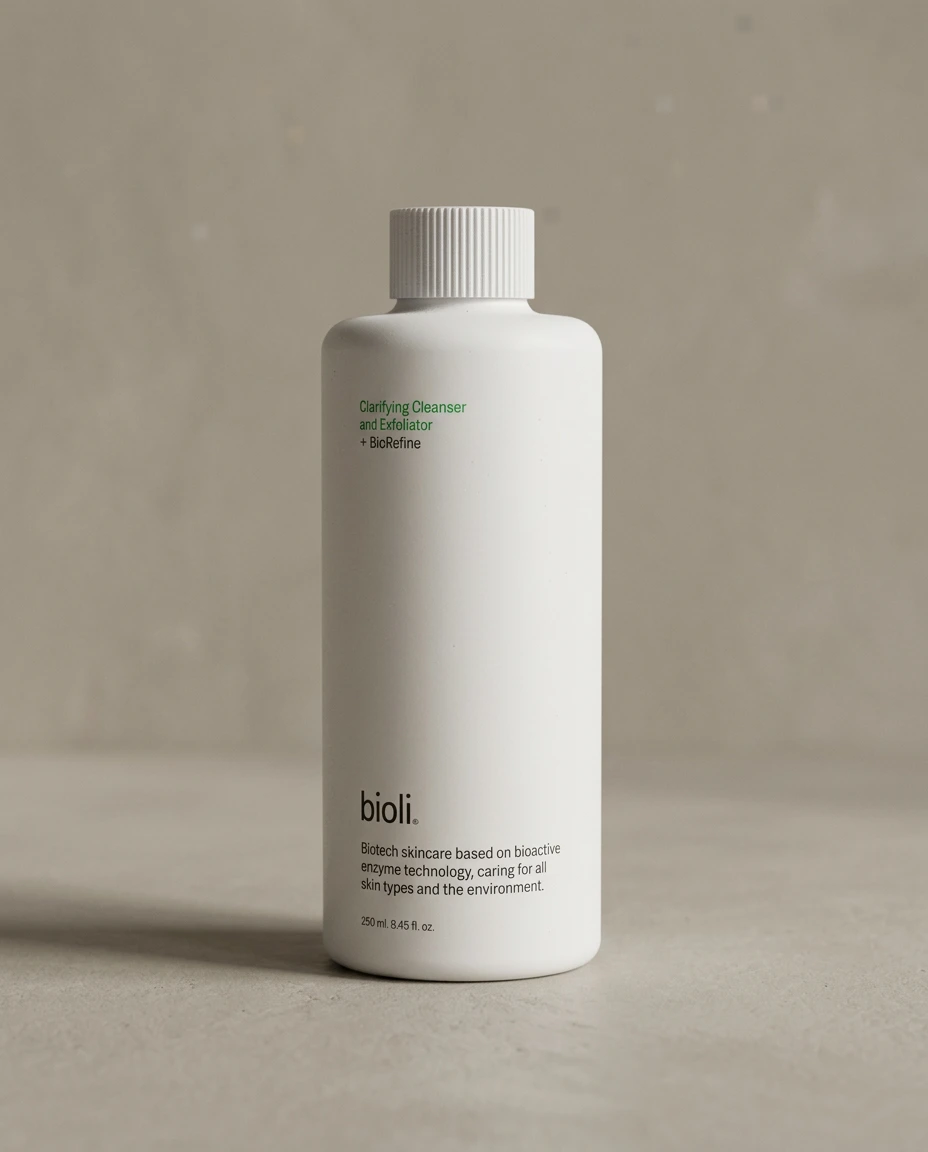
Bioli Clarifying Cleanser and Exfoliator
A fragrance-free enzyme cleanser with truly plastic-free packaging, held back by a preservative pair that sits awkwardly with its sensitive-skin promise.
♻️ Plastic-free compostable bottle
🌱 Vegan (brand’s claim)
🐰 Cruelty-free (EU law, no Leaping Bunny)
🧪 Fragrance-free
🧬 Enzyme-based exfoliation
🇩🇰 Made in Denmark
🎁 20% off with code GGG20
Best for: sensitive skin that finds acids too harsh, and anyone who wants plastic-free skincare. Skip if: you want proof of results, or you can’t home compost the bottle.
What Is It
●●●●●●●●○○ 8/10
A cleanser and gentle exfoliator for sensitive skin. Instead of the usual AHA or BHA acids, it uses two enzymes made by microorganisms: protease, which breaks down proteins, and lipase, which breaks down fats. Together they loosen dead skin cells and oils without scrubbing grains or acids. Sodium hyaluronate adds hydration.
The full ingredient list is published: Aqua, Propanediol, Betaine, Maltodextrin, Pullulan, Phenoxyethanol, Protease, Lipase, Sodium Hyaluronate, Xanthan Gum, Sodium Hydroxide, Diutan Gum, Ethylhexylglycerin, Glyceryl Glucoside. That is 14 ingredients, with no fragrance, parabens or silicones. No palm oil is listed, and the brand states the formula is 100% vegan.
The bottle is made from fermented microorganisms and, according to the brand, breaks down in home compost. The outer packaging is FSC-certified paper, so there is no plastic and no extra box.
Who Makes It
●●●●●●●●○○ 8/10
🇩🇰 Denmark
Bioli ApS is an independent Danish biotech skincare startup, founded in 2021 by Nina Wiberg Rosenquist and launched in 2025. It has no private equity backer and no corporate parent. According to the brand, it developed its products with scientists from a leading Danish university and the Novo Nordisk Foundation’s Centre for Biosustainability, with funding from Innovation Fund Denmark.
Our take: we rate Bioli 8/10 for how much it has built from first principles. The packaging is made from microorganisms, the actives are grown by fermentation, and every ingredient is disclosed. It also answers hard questions openly. Bioli shared additional documents with us that we can’t publish. We checked them ourselves, and they answered several of our open questions. That openness is what sets it apart, because many brands barely reply to hard questions.
Bioli doesn’t name its manufacturing partner, which isn’t unusual for a young brand. The certificate we reviewed covers specific types of medicines and doesn’t list creams, so it shows a regulator-inspected quality system but doesn’t directly cover this product. The partner is a small company without a formal ESG framework or sustainability report yet, something we’d like to see as Bioli grows.
Bioli says it doesn’t test on animals, as EU law requires, and we found nothing to suggest otherwise. It doesn’t hold Leaping Bunny. The brand has chosen not to pursue it, arguing that EU brands shouldn’t market what the law already requires. We understand that position for a young brand, though a certificate would add an independent check of the supply chain.
Bioli launched in 2025, and most of what’s missing is what a young brand hasn’t built yet: a published life cycle analysis, a B Corp application, an impact report, independent reviews and directory listings. We see these as points for improvement, not red flags.
How to Use
1. To cleanse: massage a small amount over damp skin, then rinse with lukewarm water. You can use it morning and evening.
2. To exfoliate: apply a small amount and leave it on as a mask for 5 to 10 minutes, then rinse. Do this once or twice a week.
3. When the bottle is empty, rinse it and put it in your home compost. If you don’t have one, it goes in general waste.
What We Like
✅ Plastic-free from bottle to bag: a bottle made from fermented microorganisms and a single FSC-certified paper bag, with no extra box.
✅ The bottle is made to break down in home compost, which is rare in skincare.
✅ Short, fully disclosed list of 14 ingredients, with no fragrance, parabens or silicones. That is rare in a cleanser made for sensitive skin.
✅ Safety checked beyond the legal minimum: the AllergyCertified label means toxicologists review every ingredient for allergens and hormone disruptors.
✅ Enzyme-based exfoliation is a credible, gentler alternative to acids, and the mechanism is well understood.
✅ Fermentation-based actives. Bioli says its lower water, energy and CO₂ claims rest on a preliminary life cycle analysis. The results aren’t published and we haven’t seen them, so we treat this as a credible claim, not a verified one.
✅ Tested under dermatological supervision on 25 volunteers with sensitive or allergy-prone skin, with no irritation reported, according to the brand.
✅ Independent Danish startup with no corporate parent, so no conflict with a bigger group’s less ethical portfolio.
What We Don’t Like
⚠️ Phenoxyethanol is in the formula. It is a permitted preservative, safe below the 1% EU limit, and it breaks down quickly in nature, but it is made from petrochemicals and some consumer apps flag it. Bioli says the preservative is needed for microbiological safety, which is fair, but it means the “No petrochemical-based ingredients” claim on its site isn’t accurate and should be reworded. The “100% biodegradable” claim is a separate issue: since 27 September 2026, EU rules ban broad claims like “biodegradable” unless they are backed by recognised proof.
⚠️ The preservative pair of phenoxyethanol and ethylhexylglycerin can irritate some skins, and ethylhexylglycerin has been flagged in studies as a possible sensitiser. Both passed the AllergyCertified review, but for a product sold to sensitive skin we’d still like the brand to address it openly.
⚠️ No published results for this cleanser. The 25-person test checked for irritation, not for whether the exfoliation works.
⚠️ No independent reviews yet. The cleanser is new, and the one testimonial on the brand’s own site is brand-curated.
⚠️ The bottle needs a home compost. Most bio-waste bins don’t accept compostable packaging, as the brand says itself. If you can’t home compost, it goes in general waste.
Why Trust It
🧪 AllergyCertified · 🏅 Tænk A-kolbe rating · ♻️ OK compost HOME · 🌲 FSC paper bag
AllergyCertified is confirmed with the certifier. The Tænk rating, OK compost HOME and FSC are the brand’s claims, which we haven’t checked in the certifiers’ own databases.
Our Experience
We used this cleanser and exfoliator ourselves for four weeks. We both have sensitive skin, and using it weekly, neither of us had any irritation. It also took off our make-up and sunscreen without a problem, even though the formula has no conventional cleansing agents. There is no perfume smell, as you’d hope from a fragrance-free cleanser, it feels soothing on the skin, and the texture feels premium.
That is two people over four weeks, not a clinical trial, and everyone’s skin is different. But even with the caveats above, it’s a cleanser we’d happily recommend.
Disclosure: Bioli sent us a sample of this cleanser to try.
There are no independent reviews yet, because the brand launched in 2025. Besides our own experience, there is a 25-person dermatological test reported by the brand.
The Verdict
A fragrance-free enzyme cleanser with truly plastic-free packaging, held back by a preservative pair that sits awkwardly with its sensitive-skin promise.
This is one of the more credible entries in eco skincare. The packaging earns its claims: a bottle made from microorganisms, a single FSC paper bag, no plastic. The ingredient list is short, fully disclosed and free of fragrance, parabens and silicones. The safety checks go beyond the legal minimum, and enzyme exfoliation is a real, gentler alternative to acids, not a label.
It isn’t perfect. Phenoxyethanol and ethylhexylglycerin sit in the formula while the brand’s site says “No petrochemical-based ingredients”, and that wording should change. The life cycle analysis is unpublished, there are no published efficacy results, and independent reviews don’t exist yet. None of this surprises us for a brand that launched in 2025, and we’d happily revisit our rating as Bioli publishes more.
Discount for GGG readers: use the code GGG20 at checkout to get 20% off.
Delivery:
🇩🇰 Denmark: 2 to 5 business days, DKK 30 to 55
🇩🇪 Germany: 3 to 8 business days, €7 (pick-up point) or €15 (home)
🇧🇪 🇳🇱 🇫🇷 🇱🇺 🇵🇱 🇸🇪 Belgium, Netherlands, France, Luxembourg, Poland, Sweden: 3 to 8 business days, €10
🇫🇮 🇬🇷 🇨🇿 🇮🇹 🇪🇸 🇵🇹 Finland, Greece, Czech Republic, Italy, Spain, Portugal: 3 to 8 business days, €10 (UPS)
🇬🇧 United Kingdom: 3 to 8 business days, £10 (UPS)
🇪🇺 Rest of Europe: €15
🇳🇴 Norway: DKK 150
🇺🇸 United States: 5 to 10 business days, $30
🇰🇷 South Korea: DKK 200
🇦🇺 Australia: AUD 45
🌍 Rest of the world: 7 to 20 business days, DKK 200
Free shipping across Europe via pick-up point on orders over €90. Outside the EU you pay import duties and taxes yourself, and parcels to the US and China may be delayed by customs.
Don’t forget to enter the code GGG20 at checkout to get your 20% off.
We earn a commission when you buy with the code GGG20.
Our Verdict
There is only one cleanser on this page for now, and we think it earns its place. Its packaging, ingredient list and openness hold up better than most cleansers we looked at. It didn’t irritate our own sensitive skin, and it removed our make-up and sunscreen without a problem. Like almost every cosmetic product, it comes with a few open questions, and we list them below.
Bioli Clarifying Cleanser and Exfoliator is our pick for sensitive skin that finds acids too harsh. It is fragrance-free and AllergyCertified, it cleanses and exfoliates with enzymes instead of acids or grains, and it comes in a plastic-free bottle you can put in your home compost. It also has open questions: its preservatives, phenoxyethanol and ethylhexylglycerin, sit awkwardly with the brand’s “no petrochemical” and “100% biodegradable” claims, and there are no published results showing how well the exfoliation works. If you already use Bioli’s Strengthening Serum or Day Cream, this is the cleanser from the same range. Choose it if your skin reacts easily, you want one product instead of a cleanser and a separate exfoliator, and you have a home compost.
Shop Face Cleanser
- Bioli Clarifying Cleanser and Exfoliator → (use code GGG20 for 20% off)
Green Goods Gallery earns a small commission when you buy with our code GGG20, at no extra cost to you. It never changes our ratings.