
Sustainable Beach Towels: Organic, Quick-Drying, and Ethical
Your beach towel is probably polyester, which is releasing microplastics into the beach and sea. Discover linen, organic cotton, and fouta hammam towels from verified ethical brands: better for your skin, better for the beach, and better than having to buy a new one next summer. Shop Like You Give A Damn (SLYGAD) is your go-to marketplace.
🌿 Natural fibres only — linen, organic cotton, and fouta cotton. No synthetic microfibre shedding microplastics into the water
🏖️ Linen outperforms cotton — faster drying, more absorbent per gram, sand-resistant, antimicrobial, lasts decades, not years
🧺 Fouta hammam format — flat-woven, lightweight, compact, sand-shedding. The most practical format for a bag or a bike
🔁 Improves with washing — unlike synthetic towels that degrade, linen and quality cotton get softer and more absorbent over time
🐄 100% vegan — no animal-derived fibres, no synthetic blends on SLYGAD’s towel section
📐 102 items — bath towels, beach towels, fouta sets, hand towels. Filter by material.
💶 From €26 — fouta formats through to premium waffle linen at €60+
The Problem With the Towel in Your Beach Bag
Most beach towels sold at this moment are made from one of two materials: conventional cotton or microfibre (polyester-polyamide blend). Both have problems that are worth understanding before your next purchase.
Conventional cotton is one of the most pesticide-intensive crops in global agriculture. Cotton occupies just 2.5% of the world’s arable land but accounts for approximately 10% of global insecticide use and 4.7% of global pesticide sales, according to UNEP. A single conventional cotton bath towel requires approximately 6,000 litres of water to produce, from field to finished textile. The towel in a fast-fashion beach set is almost certainly not organic, which means it carries a chemical residue from cultivation and processing that sits against your skin repeatedly, season after season.
Microfibre towels are the compact, fast-drying synthetic alternative sold in every sports and outdoor shop. They are made from petroleum-derived polyester and polyamide. Every machine wash releases synthetic microfibres into the water system. Studies show that 85% of shoreline pollution consists of microfibers, with these fibres too fine to be captured by most wastewater treatment systems. A microfibre beach towel that gets rinsed of salt water and then machine-washed deposits microplastics directly into the marine environment it just came back from. The performance advantage of a microfibre towel — quick drying, compact, lightweight — can be matched or exceeded by linen without the synthetic fibre footprint.
There is a better format. It has existed for centuries and makes a functionally superior beach towel for most people. It just wasn’t sold in Primark.
Why Linen Is the Right Material for Sustainable Beach Towels
Linen is produced from the flax plant (Linum usitatissimum). Flax grows naturally in the cool climate of Northern Europe, particularly Belgium, France, and the Baltic states, without irrigation, without pesticides in most organic production, and with a significantly lower water and chemical footprint than cotton. The transformation of flax into linen is mechanical rather than chemical, using little more than water retting and mechanical processing to separate and clean the fibres.
The resulting material has a set of properties that make it particularly suited to beach use:
Absorbency without water-logging: Linen fibres are hollow, allowing them to absorb up to 20% of their own weight in moisture before feeling wet — and then release that moisture rapidly. A linen towel gets you dry faster than cotton terry and dries itself within minutes rather than hours. This is the reason a linen towel hanging on a beach bag rail is usable again before your second swim, while a cotton terry towel is still damp the next morning.
Sand-shedding: The flat-woven structure of most linen towels (and fouta hammam towels) means sand does not embed in loops and carry back into the car, the bag, and the living room. This is a beach-specific advantage that terry-loop towels cannot match — the loop structure that creates softness is the same structure that traps fine sand in its pile.
Antimicrobial. Linen has natural antibacterial properties that prevent the bacterial growth responsible for the musty smell that develops in a cotton towel left damp. A linen towel used twice at the beach and hung in the sun between uses does not smell. The same cotton terry towel used twice does.
Durability: Linen fibres are approximately 30% stronger than cotton and get stronger when wet rather than weaker, which is the correct direction for a material used for swimming. A well-made linen towel softens and improves with each wash while maintaining its structural integrity for 20–30 years. Most cotton terry beach towels are replaced every 2–5 years as the pile flattens, thins, and the colour fades. Over the same 20-year period, one linen towel versus four to ten cotton replacements represents a significant difference in material, water, and energy consumed.
Weight and compactness: Linen is significantly lighter per unit of absorbency than cotton terry. A linen beach towel that absorbs the same amount of moisture weighs less in a bag, takes up less space, and dries more quickly on the line — which reduces energy use if you occasionally tumble dry.
The Sustainable Beach Towel Formats Available
Waffle Linen Towels
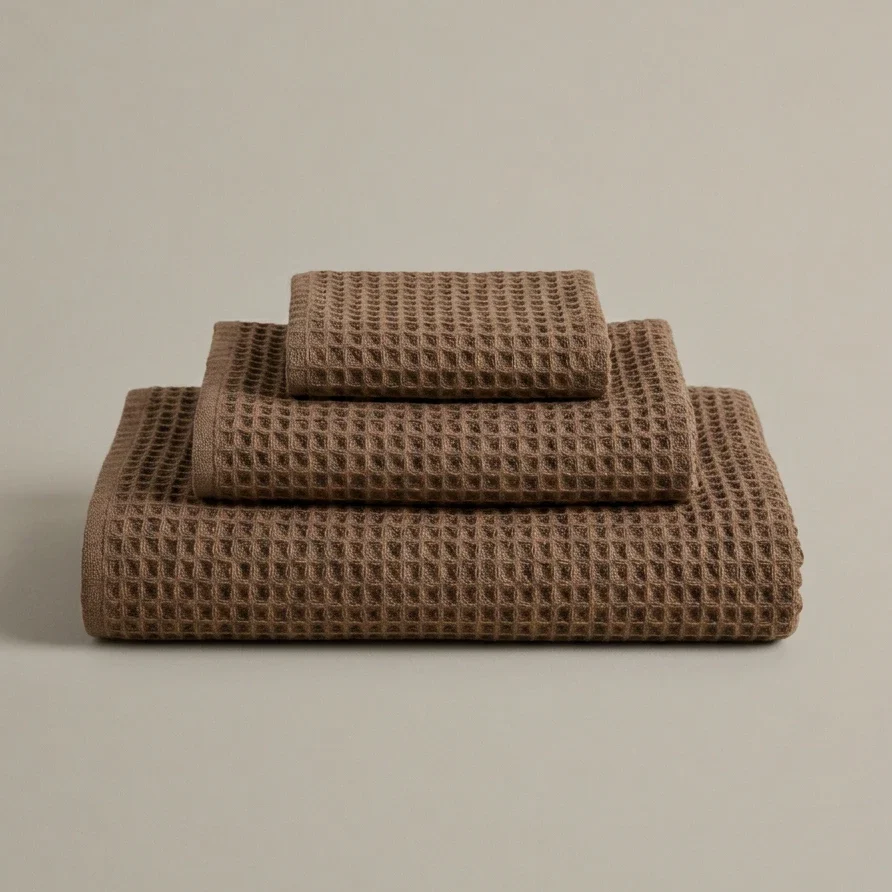
The waffle weave is a grid-structured textile that combines linen’s performance properties with more surface area per gram of material than flat-woven linen. The raised squares create absorbent contact points while the channels between them allow airflow and rapid drying. Aesthetically, waffle linen towels are the most visually versatile — they function as bath towels, beach towels, gym towels, and can fold into a compact square for travel.
Brand Spotlight: AmourLinen
Lithuanian linen. OEKO-TEX certified. Handmade. Made-to-order to prevent overproduction. The only brand on this page that exists specifically to keep a centuries-old linen tradition alive.
Lithuania has one of the oldest flax-growing and linen-weaving traditions in Europe, a heritage documented as far back as the 12th century and still practiced in rural communities across the country. AmourLinen was founded in Vilnius by Lukas to share that heritage globally, and every piece of the brand’s supply chain operates within 200km of their Vilnius workshop: the flax is grown locally, dyed at a factory less than an hour away, and handmade in a family-owned production facility in the city.
The waffle towels (€60) are their flagship bath product, a waffle-weave linen available in a carefully curated set of earthy, timeless tones (charcoal, sage green, moss green, and others) that don’t read as utilitarian or clinical the way most bath linen does. They are listed as bath towels, but the dimensions, weight, and performance make them equally suited to beach use. Two washes in, they soften noticeably. By the tenth, they’ve become the towel you reach for first.
Available as: individual towels or three-towel sets (€70 for a set of three in matching colourways — hand towel, guest towel, and bath towel sizes).
What Real Customers Say
“Great feeling towel and hard to find a price better for this kind of material (cotton/linen blend) — thank you.” — AmourLinen customer
“The throw is soooo nice! The fabric and colour are beautiful, and the waffle texture is just so nice!” — AmourLinen customer review
One honest note on linen towels for first-time users: linen sheds some threads in the first two to three washes. This is the fibre releasing excess material and is not a quality defect. It stops after the initial washes. Do not use fabric softener on linen: it coats the hollow fibres, reducing the absorbency that makes linen worth buying. Wash at 30–40°C with a gentle unscented detergent and air dry where possible.
Fouta / Hammam Towels
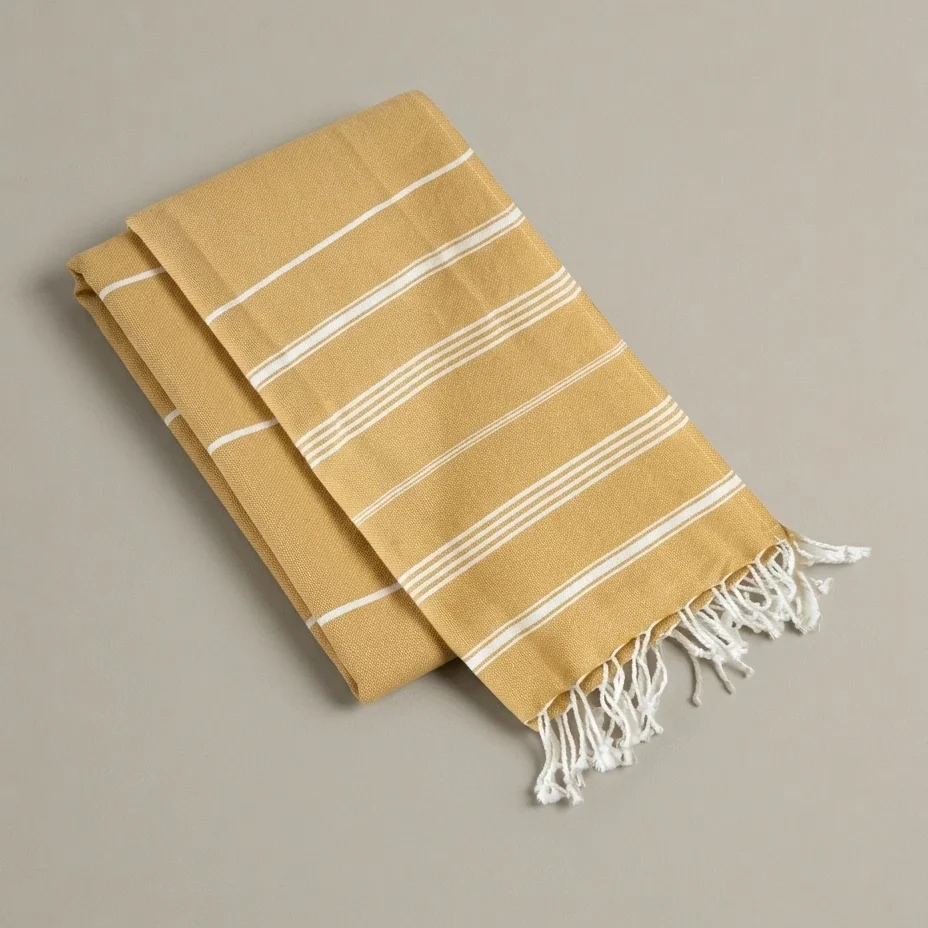
The fouta is a flat-woven cotton towel originating in North Africa and the Middle East, where it was used in hammam bathhouses precisely because it dries fast and is lightweight in a humid, high-heat environment. The modern fouta typically measures 90×180cm or larger, is flat-woven (no pile loops), absorbs well, dries rapidly, and is compact enough to serve as a beach towel, a sarong, a blanket, or a light wrap depending on the situation.
For beach use specifically, the fouta is one of the most practical towel formats available. It takes up a third of the space of a comparable terry towel in a bag, sheds sand easily from its flat surface, dries fast enough to reuse between swims, and doubles as shade cover or beach blanket when laid flat. Fouta towels on SLYGAD start from €26, the most accessible entry point in the section.
Brand Spotlight: nice to meet me
Founded by Denise and Maicol, an Austrian-Italian duo with a strong connection to the ocean, nature, and yoga — nice to meet me designs in Austria and produces in Portugal under fair working conditions. Their clothing range uses lyocell, recycled PET, and organic cotton. The fouta towel collection applies the same material logic to the hammam format: flat-woven, fast-drying, compact, and made without synthetic fibres.
The range covers everything from entry-level foutas (from €26 for the Hammam Collection) to the thicker Dolce Collection (€40), which performs closer to a conventional bath towel while retaining the sand-shedding and quick-dry advantages of the flat weave. Multiple colourways across both collections, from muted neutrals to brighter coastal tones, are available as individual pieces or sets.
For buyers who want a fouta at an accessible price from a brand with transparent production, this is the place to start.
What Real Customers Say
On fouta towels generally:
“No more bulky cotton towels that take up your whole bag and weigh you down when wet. Instead, a linen or fouta towel folds neatly into a compact roll, leaving more room for everything else.” — LinenMe review compilation
How to Choose
For the beach specifically: the fouta format is the most practical choice — compact, sand-shedding, fast-drying, and the most affordable option on the page. If you want something that also works as a standard bath towel at home, a waffle linen towel in a larger size (90×150cm or larger) covers both.
For home and beach combined: the AmourLinen waffle towel is the longer investment, more expensive upfront, made to last decades, and improves with use. At €60 for a single large towel versus replacing a conventional cotton towel every three to five years, the per-use cost comparison eventually inverts.
For a gift: the AmourLinen three-towel set at €70 is one of the most practical, sustainable home gifts available, useful immediately, doesn’t require any explanation, and will outlast almost anything else in the recipient’s bathroom.
For the lightest possible beach kit: a fouta from nice to meet me, folded flat, weighs almost nothing and takes up the space of a large paperback. Pair it with the Sol de Ibiza sunscreen tin from our sunscreen page, and you have a complete, lightweight beach kit with no single-use plastic anywhere in it.
Our Verdict
Before you buy sustainable beach towels, ask yourself: do you actually need them? If you’ve already got a beach towel, polyester or conventional cotton, it doesn’t matter. Keep using it. Running it into the ground is more sustainable than swapping it out for something with a nicer eco-label.
That being said, the towel category sits at an intersection of two environmental problems: microfibre towels contribute to plastic pollution at the beach, and conventional cotton towels carry a high pesticide footprint and relatively short lifespan. Both problems are solved by the same material choices, linen and organic cotton, in formats that perform better in actual beach conditions than the alternatives they replace.
Linen dries faster, lasts longer, resists bacteria, sheds sand, and improves with age. These are not sustainability trade-offs. They are genuine performance advantages for beach use. The fouta format adds compactness and versatility that no terry towel can match. Neither requires special care beyond a standard machine wash.
AmourLinen is the only brand in the SLYGAD towel section dedicated entirely to linen, with a documented supply chain, OEKO-TEX certification, and a made-to-order model that avoids the overproduction problem endemic to textile retail. If you’re going to buy one good towel that lasts the next twenty years, this is where to look.
Shop Sustainable Beach Towels
Green Goods Gallery earns a small commission if you purchase through these links, at no extra cost to you. We only recommend products we genuinely believe in.